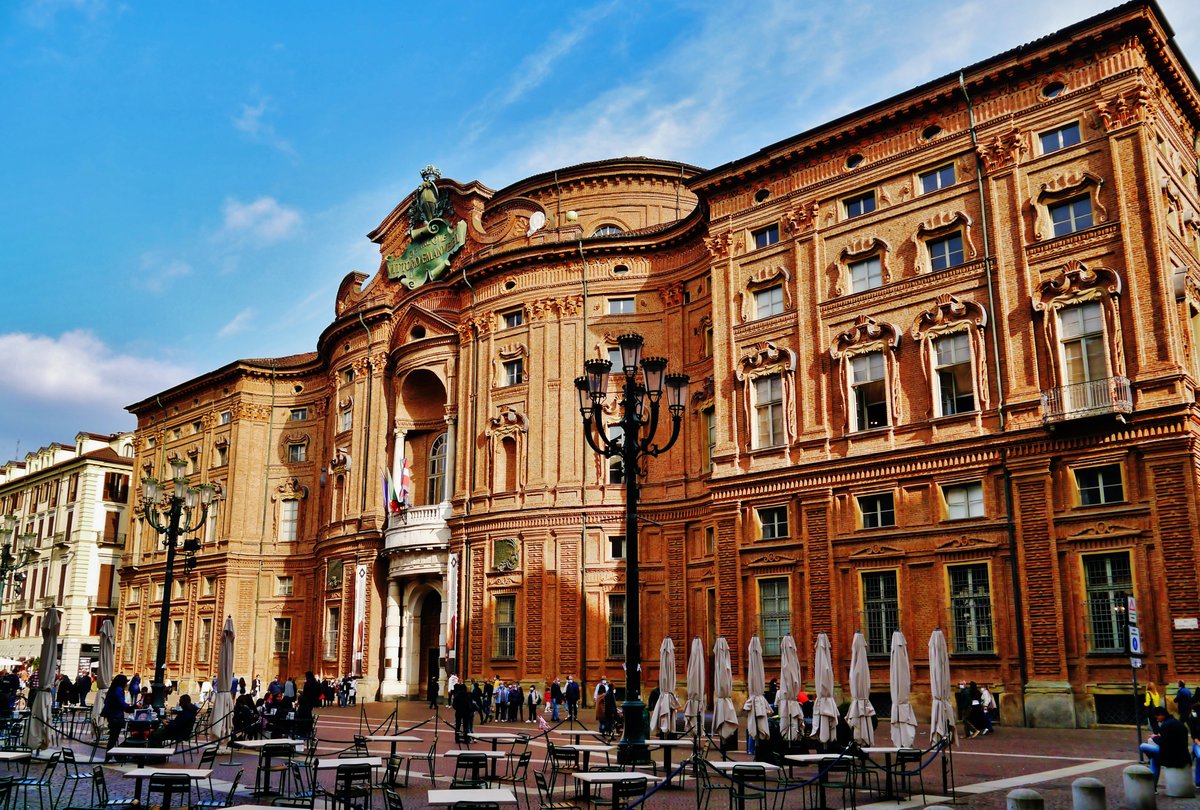

Palazzo Carignano, dubbed a UNESCO World Heritage site in Turin, is not your typical residence. It's a royal family tree, bearing witness to the births of three kings of Italy: Marie-Louise, princesse de Lamballe (b. 1749); Charles Emmanuel, Prince of Carignano (b. 1770); and Victor Emmanuel II, the first King of Italy (b. 1781 within Palazzo Carignano). Initially, commissioned by Emmanuel Philibert, Prince of Carignano, in 1679, the architect Guarino Guarini got the job to design his residence.
Curiously enough, Guarini plumped for a somewhat unexpected choice, a square structure with an elliptical façade on the westward side. The interior boasts opulent frescoes and stucco decorations, some even from the hands of Stefano Legnani, also known as il Legnanino. The elliptical main façade stands as the only known instance of civic architecture employing the undulating design of 'concave – convex – concave' introduced by Francesco Borromini in the church of San Carlo alle Quattro Fontane in Rome. Today, Palazzo Carignano serves as the Museum of the Risorgimento, unraveling the story of Italy’s unification.
Sources: Wikipedia, OpenStreetMap, Wikidata, Wikimedia Commons
Written by Nicolo Ciampini
Discuss this with the author and others
No comments yet. Be the first to start the conversation.