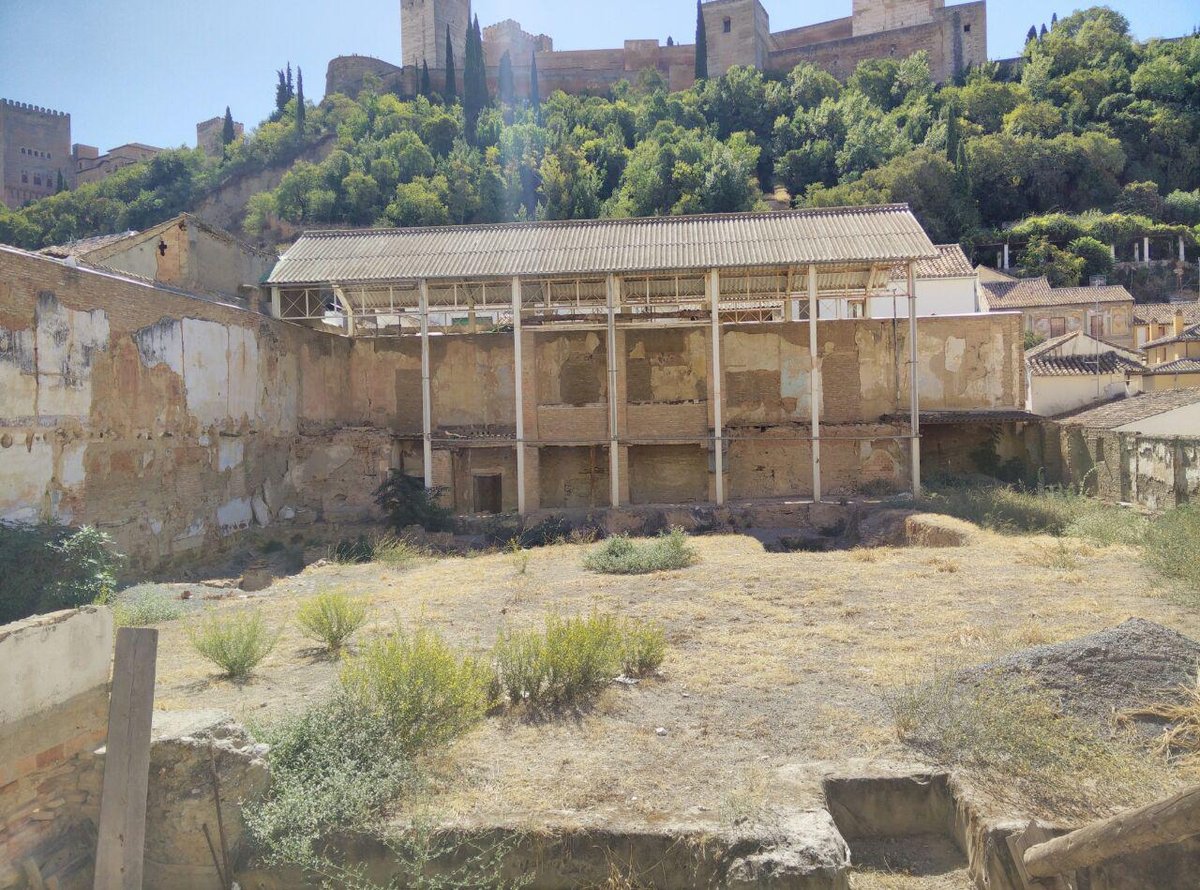

The **Maristán of Granada** ([Spanish](https://en.wikipedia.org/wiki/Spanish_language): *Maristán de Granada*) was a [bimaristan](https://en.wikipedia.org/wiki/Bimaristan) ([hospital](https://en.wikipedia.org/wiki/Hospital)) in [Granada](https://en.wikipedia.org/wiki/Granada), [Spain](https://en.wikipedia.org/wiki/Spain). It was built in the 14th century during the [Nasrid period](https://en.wikipedia.org/wiki/Emirate_of_Granada) and demolished in the 19th century.<br><br>Founded by the Nasrid sultan Muhammad V in 1365, with construction finishing in 1367, the **Maristán** was located in the lower Albaicín quarter, on the north bank of the Darro River near the 11th-century bathhouse known as the Hammam al-Yawza (today known as El Bañuelo).
The Maristans or bimaristans were the historic equivalent of hospitals in the Islamic world, first originating further east and spreading to Algeria, Morocco and Al-Andalus around the 12th to 14th centuries.<br><br>Like other maristans in the region, the Maristán of Granada was especially notable for treating mental illness, though its original medical focus may have been more general and it only slowly became specialized as an asylum for the mentally ill.
It was one of the earliest hospitals in Europe that took care of the mentally ill, with comparable institutions in Christian Spain only appearing in the early 15th century with the foundation of the Hospital of Our Lady Mary of the Innocents in Valencia, the first purely psychiatric hospital in Europe.<br><br>After the end of Muslim rule in Granada and Spain in 1492, the building was converted to other uses. In 1502, it became a mint (Casa de la Moneda).
It was later given to Mercedarian friars until the 18th century, when it was turned into a winery. Finally, it served as a tenement before being abandoned.<br><br>By the 19th century, the building was in ruins. It was eventually demolished almost entirely in 1843, with further demolitions taking place in 1984.<br><br>The **Maristán**'s restoration project began in 2020, funded in part by an investment of 1.3 million euros from the European Regional Development Fund.<br><br>The first phase of work involved consolidating and restoring the maristan's southern gallery and was completed in 2022.<br><br>As of January 2023, the site is now open to visitors and tourists.
A second phase of the project is planned to restore the rest of the site and add a more accessible entrance.<br><br>Notable Remains:<br><br> || **The Southern Gallery**: the only substantial piece of Nasrid-era architecture still standing, once opening onto the central courtyard.<br> || **The Foundations of the Therapeutic Pool**: including the recess for the stairs that patients descended into the water.<br> || **An 11th-Century Well**: discovered during the restoration works, predating the **Maristán** itself.<br> || **The Mint-Era Furnaces**: brick structures dating from the building's 16th-century conversion into a royal mint.
Sources: Wikipedia, OpenStreetMap, Wikidata, Wikimedia Commons
Written by Nik Frost
Discuss this with the author and others
No comments yet. Be the first to start the conversation.