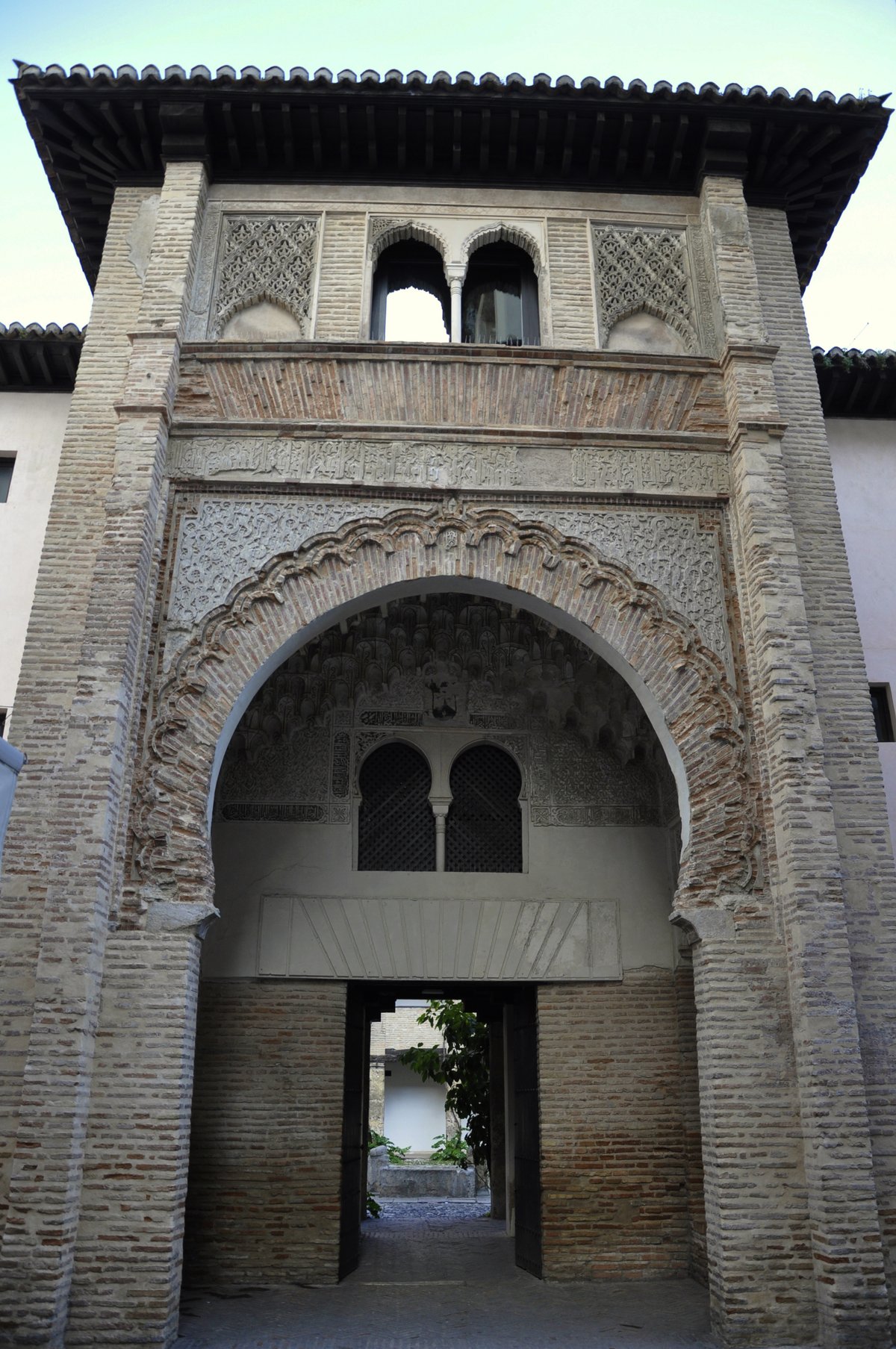

Corral del Carbón, originally al-Funduq al-Jadida, is a 14th-century historic building in the Spanish city of Granada. It is the only funduq (commercial warehouse or inn) or alhóndiga preserved from the Nasrid period in the Iberian Peninsula. The building is located south of the Albaicin quarter, near the present-day Cathedral, which was formerly the city's Great Mosque.
The building dates from the Nasrid period, likely the early 14th century. Originally serving as a commercial and trading center, it functioned as a warehouse for grain and an inn for merchants from outside the city. Because it reportedly belonged to the wives of the Nasrid sultans, it had a more monumental appearance than most funduqs in al-Andalus. A small bridge, the al-qantarat al-jadida, linked the building to the city's central bazaar, the qaysariyya, known today as the Alcaicería.
In 1494, after the fall of Granada to Christian Spain, the Catholic Monarchs granted the building to their lieutenant, Juan de Arana. After his death in 1531, the building was sold by public auction and became a theatrical courtyard until at least 1593. During this period, the interior was modified to accommodate theater audiences. In the 17th century, it was used as a residential complex, while the ground floor was used to weigh and store coal, giving it its present name.
The building was declared a National Monument in 1918 but was threatened by a state of disrepair. In 1928, Leopoldo Torres Balbás arranged for the government to purchase the property, and he oversaw a restoration from 1929 to 1931. The building's layout features a nearly square central courtyard surrounded by a three-story gallery, similar to funduqs in Fez, Morocco. Its architectural form traces back to Middle Eastern models where monumental entrances were more common, such as the iwan, while the facade ornamentation is strictly Nasrid or Moorish.
Further restoration took place in 1992 under architect Rafael Soler Márquez, with cleaning and consolidation of the facade completed in 2006. Today, the building serves as a tourist attraction and houses offices for the City of Granada Orchestra and the International Festival of Music and Dance of Granada.
Sources: Wikipedia, OpenStreetMap, Wikidata, Wikimedia Commons
Written by Nik Frost
Discuss this with the author and others
No comments yet. Be the first to start the conversation.