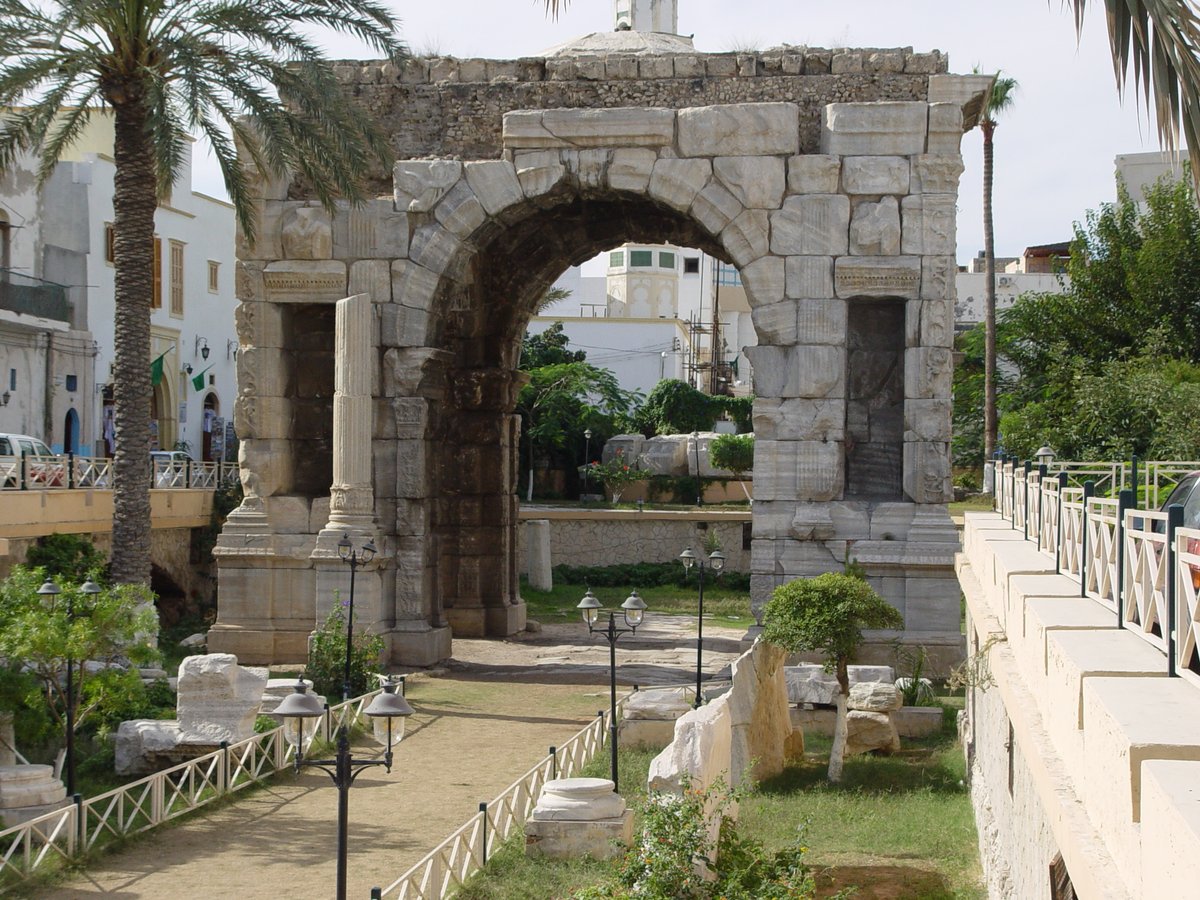

Near the northeastern entrance to the Medina in the city of Oea, now modern Tripoli, stands the Arch of Marcus Aurelius. This Roman triumphal arch is a quadrifrons structure surmounted by an unusual octagonal cupola. It was erected entirely in marble by Gaius Calpurnius Celsus, quinquennial duumvir of the city, to commemorate the victories of Lucius Verus over the Parthians in the Roman–Parthian War of 161–66.
The monument was erected in 165, a date determined because the Emperor is referred to with the title Armenicus, but not with the titles of Medicus and Parthicus, which were conferred in 166. The two front pediments feature the patron deities of the city, Apollo and Minerva, in bigae drawn by griffons and sphinxes. Other interpretations take the figures to represent Lucius Verus and the goddess Roma.
Four niches on the northeast and southwest faces of the arch are now empty, but they once contained statues of the Emperor and Lucius Verus, which were recovered during excavations in the nineteenth century. The arch received conservation and restoration work from the Italian administration between 1914 and 1918, while the surrounding zone was reorganized in the 1930s. Today, the arch suffers from poor maintenance, damage from visitors, and the effects of acid rain.
Sources: Wikipedia, OpenStreetMap, Wikidata, Wikimedia Commons

Written by Mutabor
Discuss this with the author and others
No comments yet. Be the first to start the conversation.