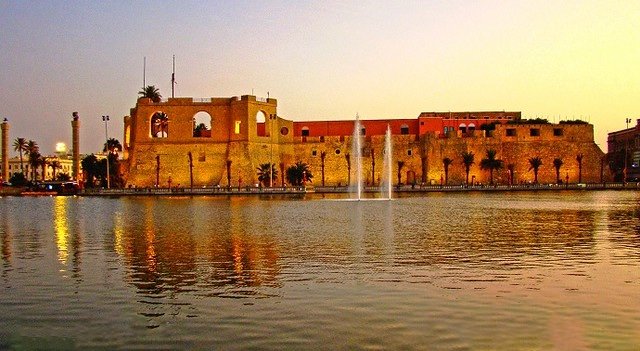

The Red Castle, known in Arabic as As-saraya Al-hamra, is a major landmark on the waterfront of Tripoli, bordering Martyrs' Square. Its origins may be as old as the Phoenician foundation of Oea in the 7th century BCE, with excavations finding remains dating back to Roman times. The building has served as the home of the Red Castle Museum since 1919 and the Libyan Department of Archaeology since 1952.
The fortress has been held by various powers, including the Vandal Kingdom, the Roman Empire, the Byzantines, the Umayyad Caliphate, the Fatimid Caliphate, the Zirid Emirate, the Crown of Aragon, the Knights Hospitaller, and the Ottoman Empire. Much of the current structure dates from the period of rule by Aragonese military commanders and the Knights Hospitaller until their expulsion by the Ottoman Empire in 1551. It is said to have been painted red ochre during that time, giving it its current name.
After the Italian conquest of Libya in 1911, the castle was used as a residence for the Italian governor-general. In 1919, it was converted into a museum, the first in Libya's history. Between 1922 and 1923, architect Armando Brasini refurbished the building, modifying the Saint George Bastion and building iconic arches above the eastern bastion. The building served as an office for Governor Italo Balbo in the 1930s and was later protected under the British Military Administration from 1942.
Sources: Wikipedia, OpenStreetMap, Wikidata, Wikimedia Commons

Written by Mutabor
Discuss this with the author and others
No comments yet. Be the first to start the conversation.