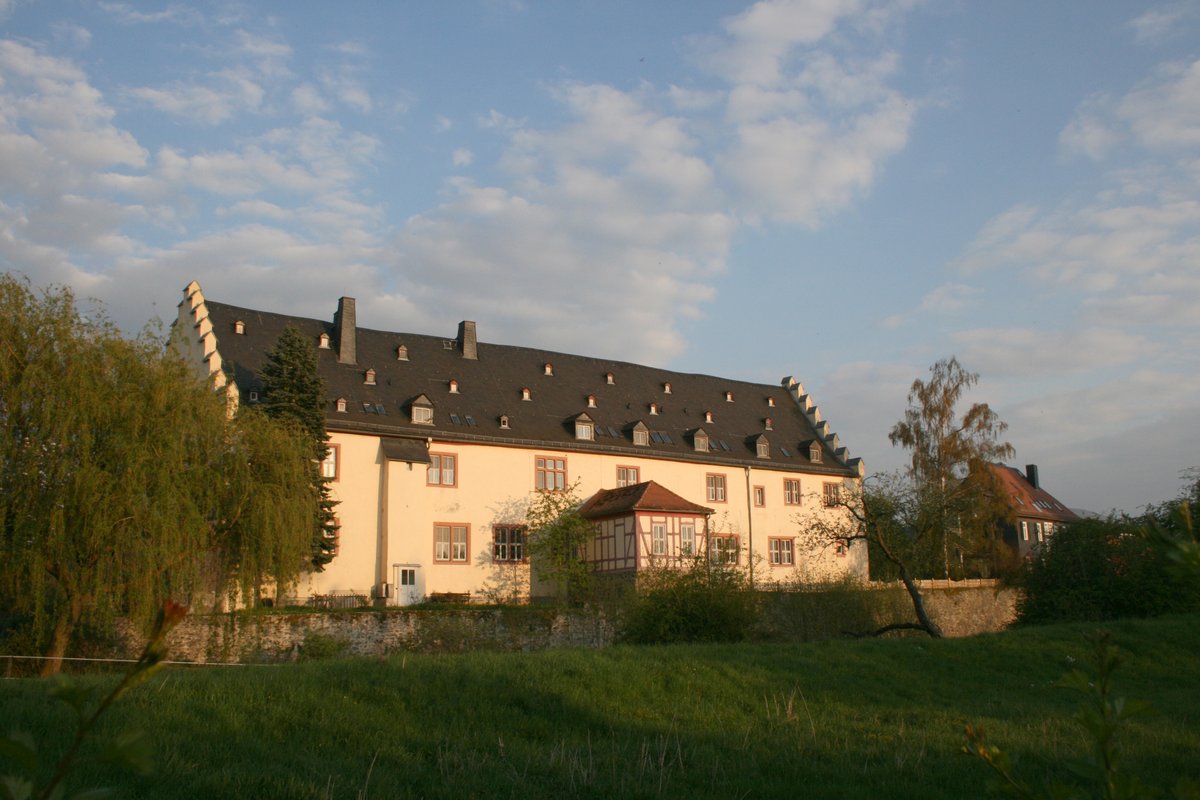
Schloss Bingenheim is a castle complex built between the 15th and 17th centuries, growing out of an older medieval fortification. Long before the current residence was established, a fortification preceding the castle was first mentioned in 1064. The site has history dating back to 817, and a Roman Limes ran nearby during Roman times. The castle originally served as an administrative center for the Fuldische Mark belonging to the Abbey of Fulda, which occupied the site with castlemen from the 13th to the 15th century.
The castle changed hands through various owners over the centuries. In 1357, Prince-Abbot Heinrich VII of Fulda received permission from Emperor Charles IV to elevate the nearby settlement to a town, though this did not happen. Fulda sold the castle to Philipp I of Nassau-Saarbrücken in 1423, after having mortgaged it as early as 1410. It was also owned by the Lords of Hanau, and in 1570, it fell to Ludwig IV of Hesse-Marburg, before passing to Hesse-Darmstadt in 1604.
In 1648, Landgrave Georg II of Hesse-Darmstadt transferred the office of Bingenheim to his son-in-law, Wilhelm Christoph of Hesse-Homburg. Wilhelm Christoph resided in the castle and was titled Landgrave of Bingenheim. He remodeled the complex to fit his needs and the style of the era. Two stone tablets in German and Latin on the portal of the Langen Bau testify to his construction work, which included a renovation in 1675. The Langen Bau was the actual residential building of the Bingenheimer Landgraves, a two-story building featuring prominent stepped gables and Gothic pointed arch doors.
The Kernburg contains two main buildings: the Hohe Bau and the Lange Bau. The four-story Hohe Bau is the oldest part of the complex, featuring corner turrets protruding on brackets characteristic of Late Gothic architecture. A staircase building was added to the Hohe Bau in 1679. To serve the household, a cubic kitchen building with a mansard roof was added in the second half of the 18th century, and a princely official house with ornamental half-timbering was built in the Vorburg in 1723.
Today, the Vorburg and Kernburg are surrounded by deep, currently dry moats. A three-arched stone bridge provides access to the Vorburg, replacing a drawbridge that was replaced by a two-arched stone bridge in 1729. Traces of the curtain wall are still visible on the Hohe Bau. Since 1962, the castle has been owned by the Lebensgemeinschaft Bingenheim, which has operated a healing and nursing institute for children, adolescents, and adults there since 1950. Modern, functional buildings were constructed in the area of the Vorburg for the institute. Interior tours of the castle are not possible.
Sources: Wikipedia, OpenStreetMap, Wikidata, Wikimedia Commons

Written by Aurora
Discuss this with the author and others
No comments yet. Be the first to start the conversation.