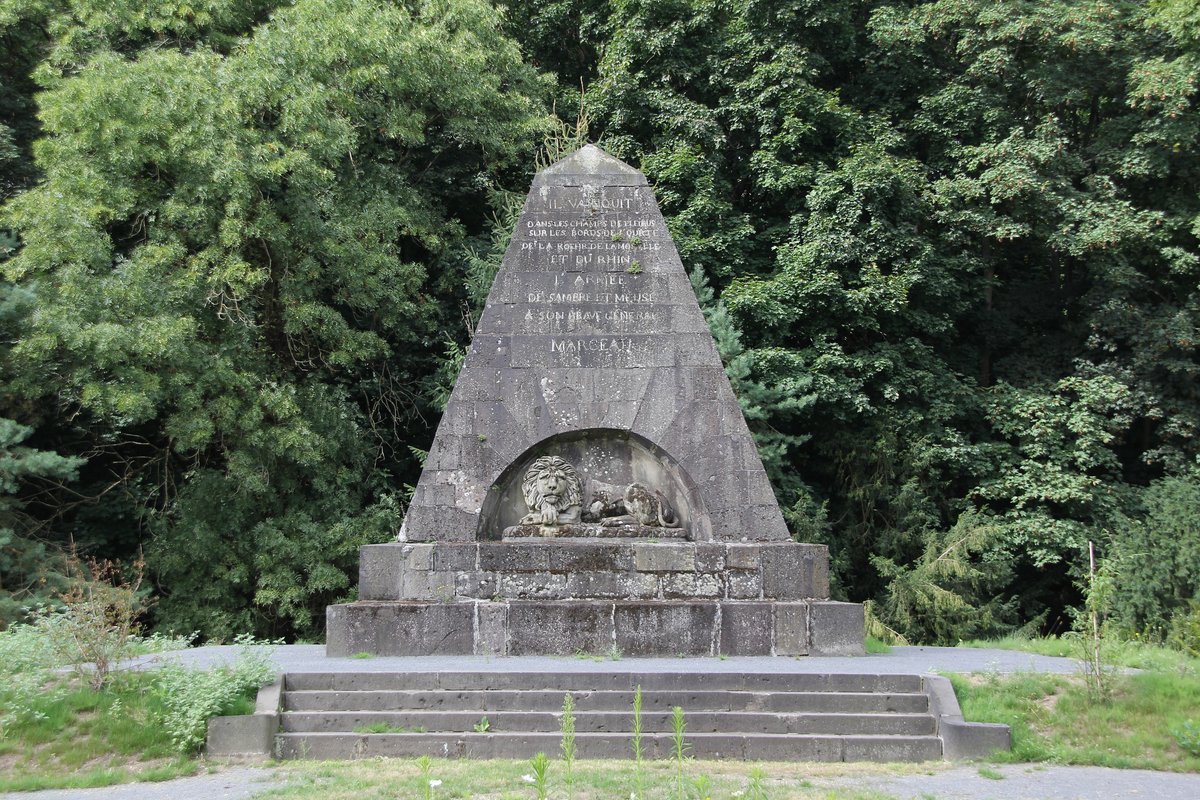
A truncated pyramid of Mendinger basalt lava rises from the grass of the Franzosenfriedhof. It stands as a tribute to François Séverin Marceau, a French revolutionary general who fell in battle at the age of twenty-six. He was a man of swift rise, a soldier at sixteen and a general by twenty-two, who died on the final day of the Year IV of the French Republic while shielding his comrades from pursuit.
Marceau took the city of Koblenz in 1794, ending the long rule of the Archbishops of Trier. During a retreat from Franconia, he was tasked with covering the movements of the Sambre and Meuse Army. On September 19, 1796, while making dispositions to leave the Höchstenbach forest, a bullet struck him. He lived only two days, dying in Altenkirchen in the arms of French and Austrian generals alike. His body was brought back to Koblenz and buried with military honors on the northern end of the Petersberg in Lützel.
His friend, General Jean-Baptiste Kléber, organized a collection among the officers to fund a lasting memorial. By 1797, the pyramid stood on the site, designed by Peter Joseph Krahe and built by Georg von Trosson. It was intended to house Marceau's remains, which were exhumed and cremated for the purpose. The urn was inscribed with the words HIC CINERES, UBIQUE NOMEN - Here are the ashes, the name is everywhere.
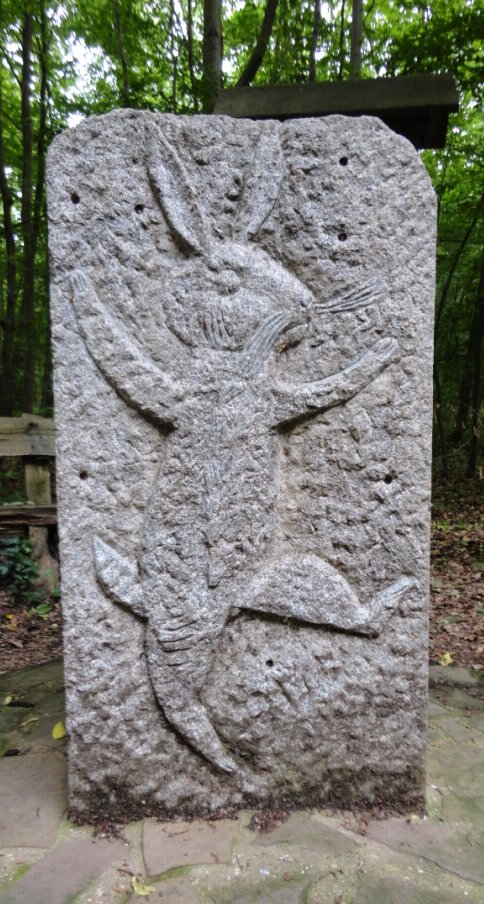
The story of the monument is one of interrupted permanence. In 1804, grave robbers broke into the pyramid searching for valuables. They smashed the original trophy relief and made off with the urn. The remains were eventually kept by a French Prefect before finding a final resting place in the Panthéon in Paris in 1889. To hide the damage, the robbers' entry point was sealed with a lion relief, which remains today in a semi-circular niche on the front of the monument.
History nearly erased the pyramid entirely in 1817 when it was dismantled to provide stone for the Bubenheimer Flesche. However, public outcry forced King Friedrich Wilhelm III to order its reconstruction in 1818. The new structure used most of the original stones, though the bottom step sits lower today because some of the original block were lost to the construction of the Flesche.
Today, the monument survives as a geometric silhouette against the trees. It remains a place of layered memory, where the four sides describe the work of a fallen general. A French soldier cemetery was built around it during the Franco-Prussian War, and it underwent restoration in the 1950s with help from French occupation troops. A restoration was carried out in 2013/2014, which included repairs to the lion relief, preserving the mark left by the thieves two centuries ago.
Sources: Wikipedia, OpenStreetMap, Wikidata, Wikimedia Commons
Written by Aurora
Discuss this with the author and others
No comments yet. Be the first to start the conversation.