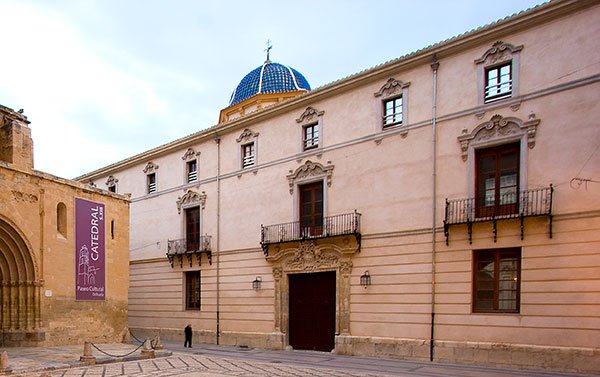

The Bishop Palace of Orihuela, a Spanish religious building of the Baroque style from the 18th century, is a testament to the opulence of the time. Situated in Orihuela, the capital of the homonymous diocese of Orihuela, this palace was the residence of the Bishop of Orihuela. In 1975, it was declared a Monument National. Today, it houses the Museum Diocesan of Art Sacro, which displays masterpieces like ‘The Temptation of St. Thomas Aquinas’ by Velázquez. Yet, how did such an art collection find its way into this palace?
The solar that currently houses the palace was previously occupied by various buildings. In the 15th century, one of the hospitals of the city was built on the site, named the Hospital del Corpus. The Hospital del Corpus was owned by the Cathedral of Orihuela. The Hospital was built in the Gothic style. From the 16th century onward, the hospital was moved to the arrabal Roig area. The hospital changed its name to San Bartolomé in the new location. In the 18th century, many canons built their own palaces and houses, leaving the vacant old residence. The new bishop constructed a new palace on the land adjacent to the Holy Church Cathedral.
The palace has two facades: the northern and the southern. The northern is the main facade and is located on Calle Mayor in Orihuela. The southern facade is located on the bank of the Rio Segura. The bishop's palace has three main parts:
1. The Capilla del Loreto, which was part of the cathedral and housed the Cofradía del Loreto’s previous cera factory. The building was reconstructed in its entirety and now houses the private chapel of the Bishop. The cofradía’s mayordoms donated the chapel to the bishop, who built a chapel on consecrated ground (the Loreto Chapel below belongs to the cathedral of Orihuela). The chapel is a square-shaped structure built in the 18th century, in a Baroque style decorated with pilasters topped with composite capitals.
The Temptation of St. Thomas Aquinas by Velázquez hung in the chapel until it was moved to the cathedral of Orihuela. The grand canvas, one of the only secure works of the painter preserved in Spain outside of the Museo del Prado, later returned to the palace, but is now displayed in the Museum Diocesan of Art Sacro.
Sources: Wikipedia, OpenStreetMap, Wikidata, Wikimedia Commons
Written by Nicolo Ciampini
Discuss this with the author and others
No comments yet. Be the first to start the conversation.