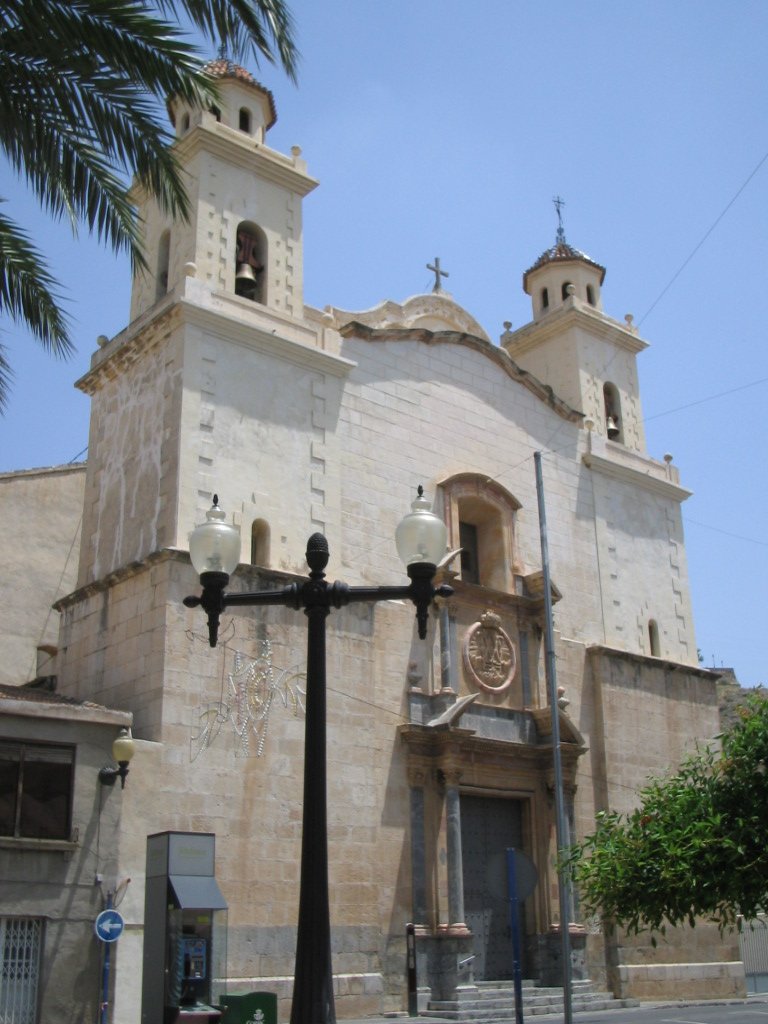

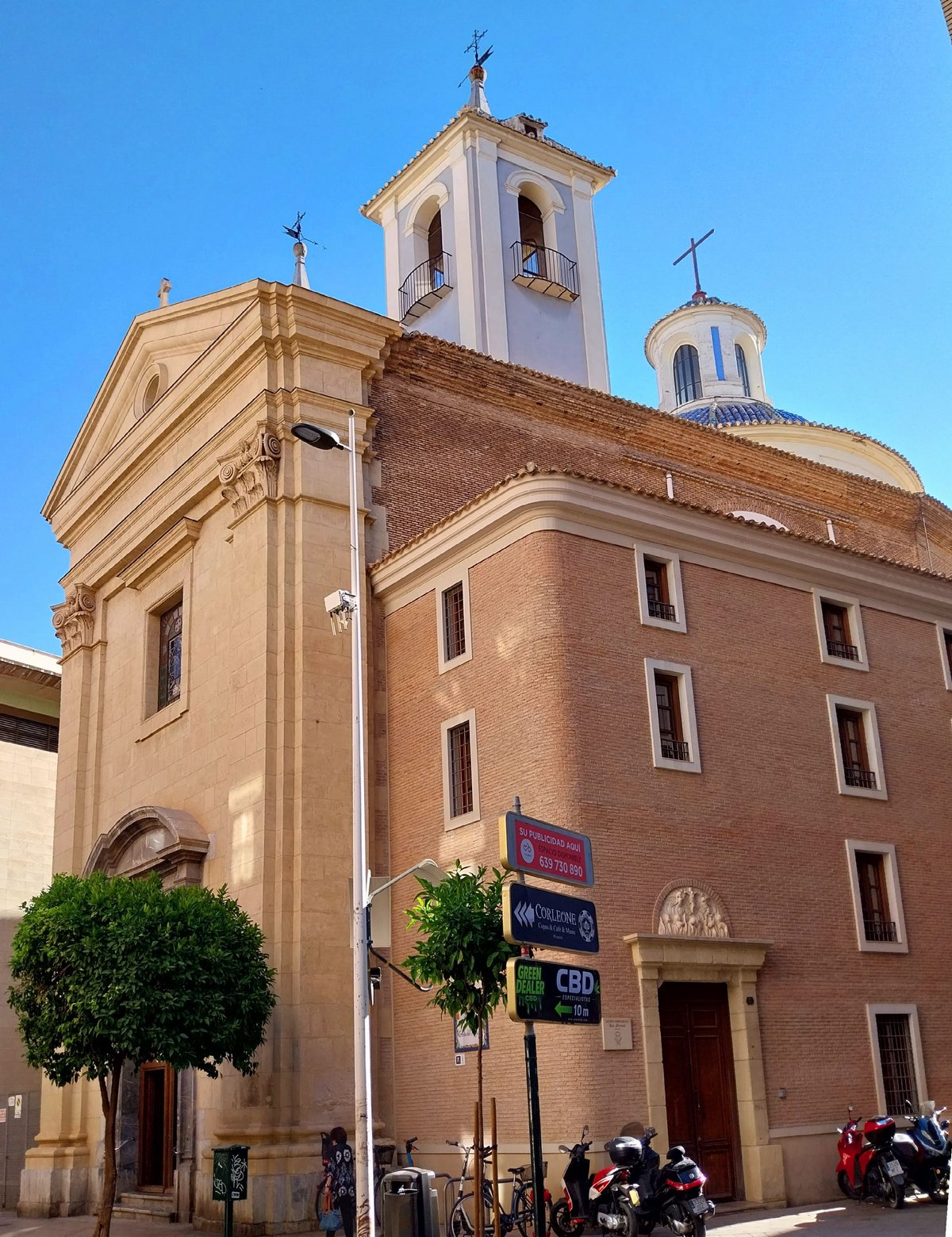
The Santuario de Nuestra Señora de Monserrate de Orihuela is located outside the city walls in the arrabal Roig or Rabaloche. It houses the patroness of the city, and its history is indissolubly linked to the city since before its reconquest. Its architecture is grand and belongs to the period of the neoclassical era.
Pascual Madoz describes the sanctuary in his 1845 Dictionary as the most important in the city of Orihuela. The image was venerated in the time of the sarracenos by those gathered in the arrabal Roig and the church of San Juan under the title of Nuestra Señora de la Puerta. Because of fear of profanation, it was hidden under a bell and found in the year 1306. The name Monserrat was chosen by lot among the denominations proposed by the colonies of Catalans, Valencians, and Aragoneses resident in the city. A later sentence by the Pope castellanized the name to Monserrate.
The current structure was built in the middle of the 18th century. The main entrance and facade are on the square itself. The church's main altar is made of wood, and the organ, pulpit, spacious sacristy, and two main towers made of stone are all part of the design. A provisional tower holds three bells. A cofradía, or brotherhood, is founded in this hermitage composed of the older inhabitants of the city, the orchard, and the countryside. The image is the patron of the population, and when a public calamity occurs, it is taken in procession to the cathedral.
The image, made of olive wood and 42 cm tall, was found in a hole made in the mountain. When found, according to several manuscripts, it had a child in its hand who had a bird in its fingers and was dressed in red with a blue mantle.
Sources: Wikipedia, OpenStreetMap, Wikidata, Wikimedia Commons
Written by Nik Frost
Discuss this with the author and others
No comments yet. Be the first to start the conversation.