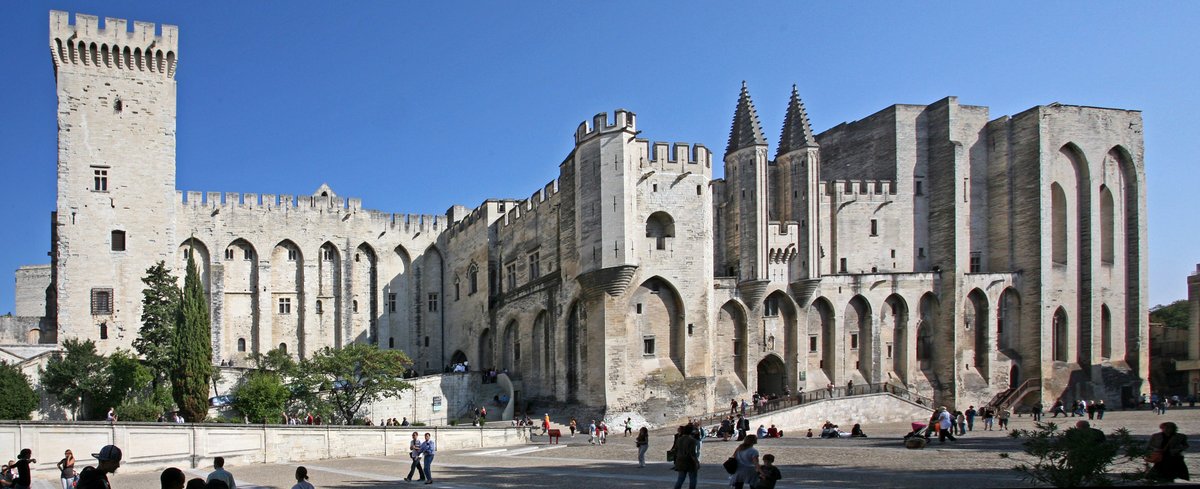

The Palais des Papes in Avignon was a fortress and palace that served as a seat of Western Christianity during the 14th century. Built on a natural rocky outcrop overlooking the river Rhône, the site was originally the old episcopal palace. Its construction was enormously expensive, consuming much of the papacy's income. It was designed by architects Pierre Peysson and Jean de Louvres, while its lavish ornamentation was the work of students from the School of Siena, Simone Martini and Matteo Giovanetti.
The Palais is actually two joined buildings: the old palais of Benedict XII, which sits on the impregnable rock of Doms, and the new palais of Clement VI. Together they form the largest Gothic building of the Middle Ages. Under Clement VI, a 52-metre long Grand Chapel was built to serve as the location for papal acts of worship. The interior was sumptuously decorated with frescos, tapestries, paintings, sculptures, and wooden ceilings.
Due to its immense size, the Palais facilitated the centralisation of services and the adaptation of operations to suit the needs of the papacy. The manpower of the Curia reached 500 people by 1316, with over 1,000 lay officials working within the Palais. It also housed a papal library that was the largest in Europe at the time, holding over 2,000 volumes, which attracted clerics passionate in the study of belles-lettres, including the founder of humanism, Petrarch.
Despite its importance, the Palais became obsolete when the papacy found it necessary to return to Rome. The hope of reuniting Latin and Orthodox Christians, along with the achievement of peace in the Papal States in Italy, made the case for returning stronger. Both Urban V and Gregory XI held the strong conviction that the seat of the papacy could only be the tomb of St Peter. They found the means to return to Rome in 1362 and 1370, respectively.
Today, the Palais des Papes is a UNESCO World Heritage Site. It retains a sense of beauty, simplicity, and grandeur that French poets have described as a work of destruction over the centuries. It remains a significant example of the International Gothic architectural style, preserving the history of the Avignon Papacy.
Sources: Wikipedia, OpenStreetMap, Wikidata, Wikimedia Commons

Written by Nicolo Ciampini
Discuss this with the author and others
No comments yet. Be the first to start the conversation.