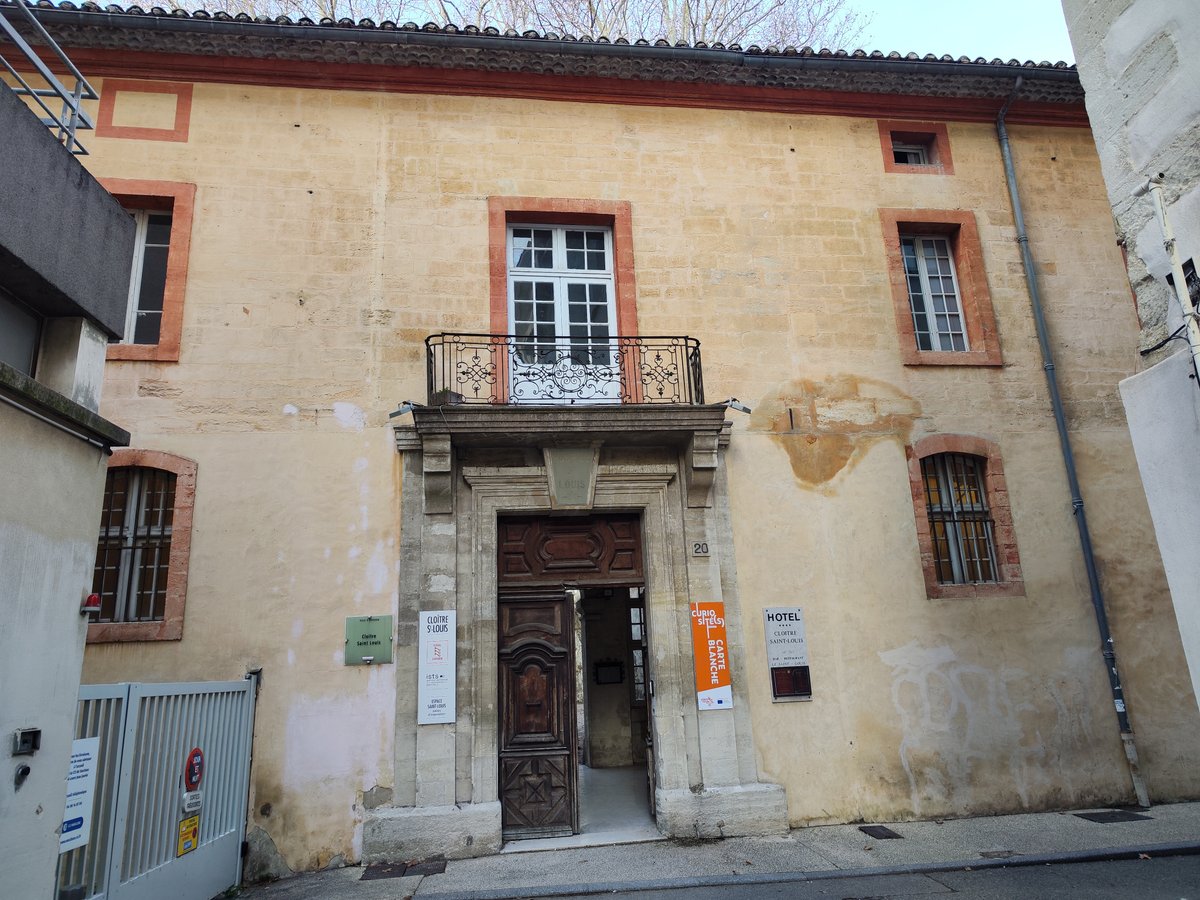

The Jesuits established a college in Avignon in 1564 and soon sought to add a noviciate. This new establishment was finally made permanent in 1589 thanks to a significant donation from Louise d'Ancezune. The building served as a religious training house for novices until the Jesuits were expelled from France in 1768. After passing through several hands, it became the property of the city of Avignon in 1852 and served as a civil hospice for 40 years.
In 1987, the site was rehabilitated by Jean Nouvel to be transformed into a hotel. Today, it is a place of multiple uses, primarily focused on tourism and culture. While parts of the building serve as a luxury hotel, other sections are reserved for the Institut supérieur des techniques du spectacle d'Avignon, as well as for exhibitions and performances during the Festival d'Avignon.
The architecture of the site features a chapel with a rare plan, topped by a dome on a drum. The architect Étienne Martellange designed the drum with openings grouped in pairs on the diagonals rather than along the axes. Nearby, the central courtyard features a vaulted gallery on three sides, which is technically not a cloister as the Jesuits, novices, and fathers were not actually cloistered.
The buildings around the courtyard were started during Martellange's time and continued in 1627 by François de Royers de la Valfenière. The oldest wing, which began under Martellange and was remodeled in the 1680s, is now used for the hotel. Other sections, including the southern wing, were developed later in the 17th and early 18th centuries, featuring a spectacular flat vault at the entrance completed by Jean-Baptiste I.
The entire building and the cloister have been listed as historical monuments since December 13, 1950. Located at Rue du Portail Boquier 20, the site blends the charm of the 17th century with 21st-century modernity.
Sources: Wikipedia, OpenStreetMap, Wikidata, Wikimedia Commons

Written by Nicolo Ciampini
Discuss this with the author and others
No comments yet. Be the first to start the conversation.