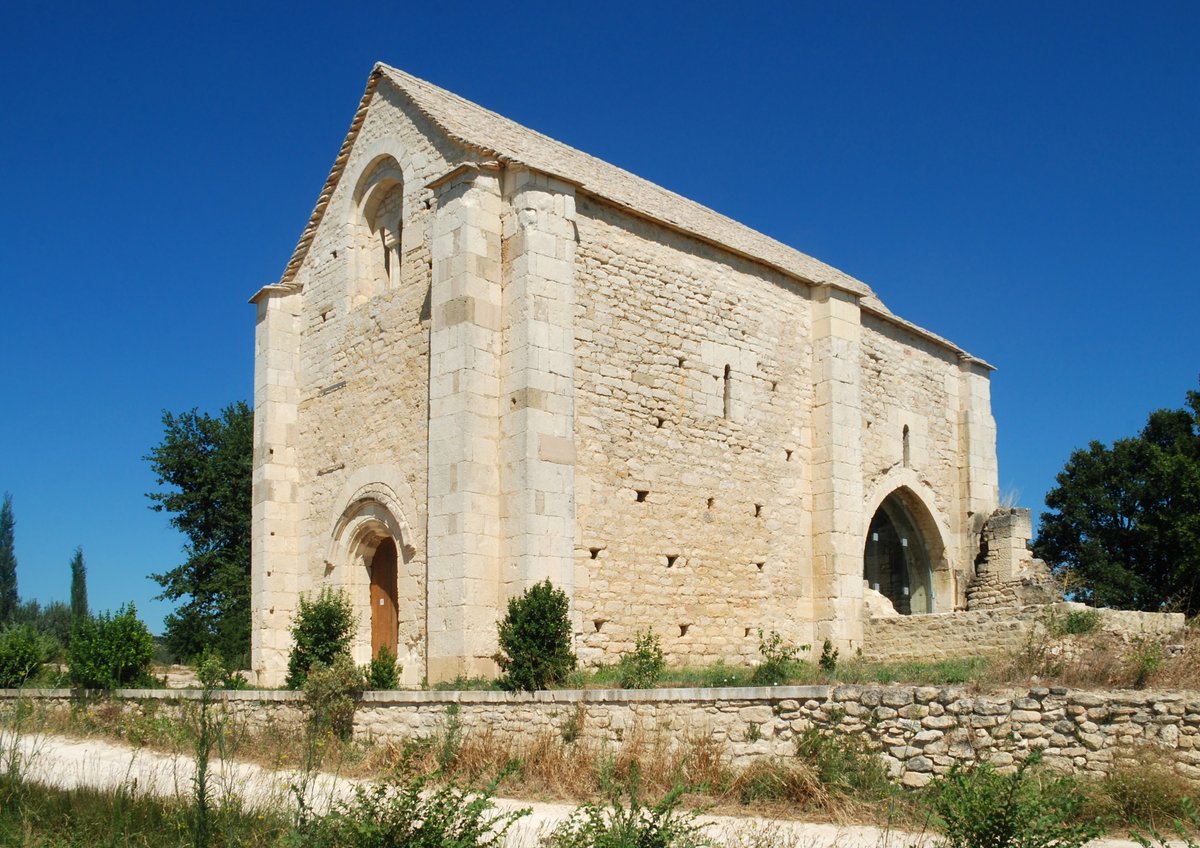

What happens when you walk to the end of the chemin de la Clastre? You find a chapel sitting all by itself in a vineyard. This is the Chapelle Saint-Étienne, also known as the chapelle de la Clastre. It is a Romanesque chapel located in Saint-Hilaire-d'Ozilhan in the Gard department, enduring since the 12th century as a remnant of the medieval era.
One door features a lintel made from a hard stone monolith that could not have been obtained from the local quarries. Instead, the building utilizes an antique door threshold provided to serve as a lintel. This distinct architectural choice highlights the history of the structure, which was remodeled in the 12th century and remains a recognized historic site.
While the surrounding village changed its name frequently - from Castrum Sancti Hilarii in 1121 to Locus de Sancto-Ylario in 1312, and finally to Saint-Hilaire-d'Ozilhan in 1551 - the chapel stayed put. It was officially listed as a monument historique on September 16, 1994, a date from which it underwent a renovation that included the restoration of its limestone roof.
Today, the chapel stands as a preserved part of the local landscape. Visitors can see the architectural details of this medieval site, situated at the end of the path near the road to Fournès, surrounded by the vines of the Occitanie region.
Sources: Wikipedia, OpenStreetMap, Wikidata, Wikimedia Commons


Written by Nicolo Ciampini
Discuss this with the author and others
No comments yet. Be the first to start the conversation.