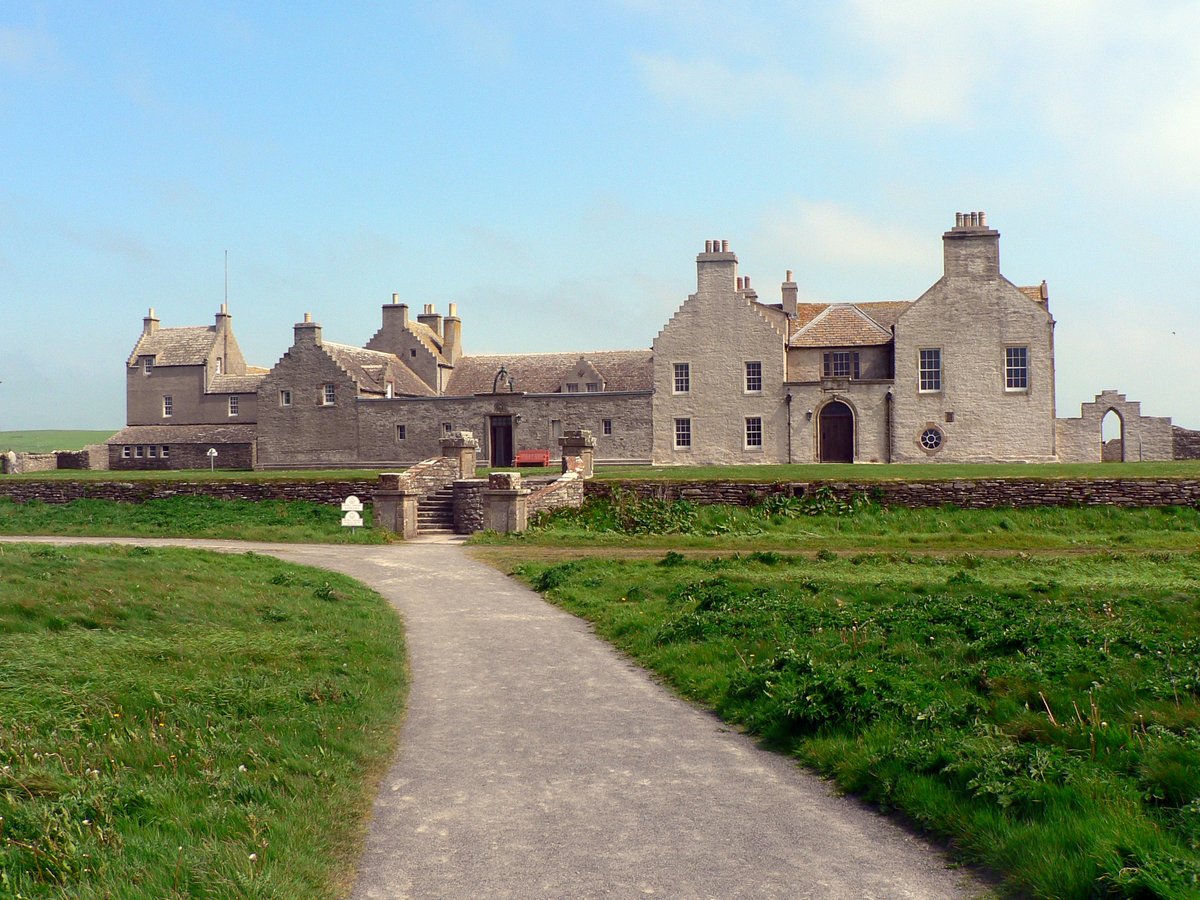
Standing near Skaill House, it's hard to imagine its historic significance climbing the Orkney hills. Overlooking the Neolithic site of Skara Brae and the Bay of Skaill, Skaill House carries a legacy that spans over 'over 10 centuries', making it one of the most complete 17th-century country mansions in Orkney. Constructed in 1620 by Bishop George Graham, the house overlooks the Neolithic site, Skara Brae, which lends a mystical quality to the mansion. Although the lands were inhabited from Neolithic times, the name Skaill derives from the Old Norse word for ‘hall’.
The property, which was once held by the Bishop of Orkney, was progressively expanded over the years. The oldest parts of the house were constructed in the early 17th century and the building is rendered with harl, while some parts of the gables are crow-stepped. There is also a stableyard with a brewhouse and harness room, a dovecote dating to the 18th century, and a presumed Pictish burial ground at the north of the main buildings.
In 1615, Patrick Stewart, 2nd Earl of Orkney, was executed for treason. Following his execution, the lands were given to the Bishop of Orkney. However, it's worth mentioning that Skaill House was constructed in 1620.
After six years of restoration work, Skaill House was opened to the public in 1997. Today, the house can be rented as a holiday home or for receptions and events. With its rich history, Skaill House stands as a testament to the stories and experiences that shaped the Orkney Islands over the centuries.
Sources: Wikipedia, OpenStreetMap, Wikidata, Wikimedia Commons
Written by Nicolo Ciampini
Discuss this with the author and others
No comments yet. Be the first to start the conversation.