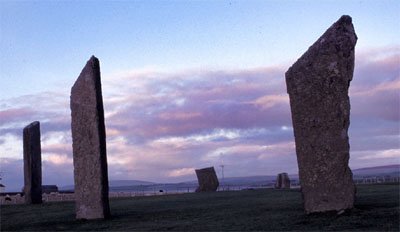
The Stones of Stenness are more than an ancient monument. They are markers of time, a physical manifestation of the Stone Age, and a testament to the human capacity to carve meaning from the land. Named 'Stane-is' – Stone Headland – in Old Norse, they are five miles northeast of Stromness on Orkney's mainland, a location that speaks volumes about their importance. Sited on a promontory at the confluence of the streams leading into Loch of Stenness and Loch of Harray, the stones are the oldest henge site that we know of in the British Isles.
The Neolithic people marked the sacred spot with a stone circle of up to 12 thin slabs, each around 30 cm thick and angled sharply. Four of these stones are still standing at over 5 metres high, forming a rough oval, with a fifth stone, the Watch Stone, erected outside the circle to the northwest. The stones were carefully arranged according to a cosmic design: pointed toward the centre of the ring and aligned with two hills, this, it is believed, was to unify the heavens and the earth.
Although the encircling ditch no longer exists, archaeological evidence suggests it once did. Today, the Stones of Stenness form part of the Heart of Neolithic Orkney World Heritage Site, managed by Historic Environment Scotland.
Sources: Wikipedia, OpenStreetMap, Wikidata, Wikimedia Commons
Written by Nicolo Ciampini
Discuss this with the author and others
No comments yet. Be the first to start the conversation.