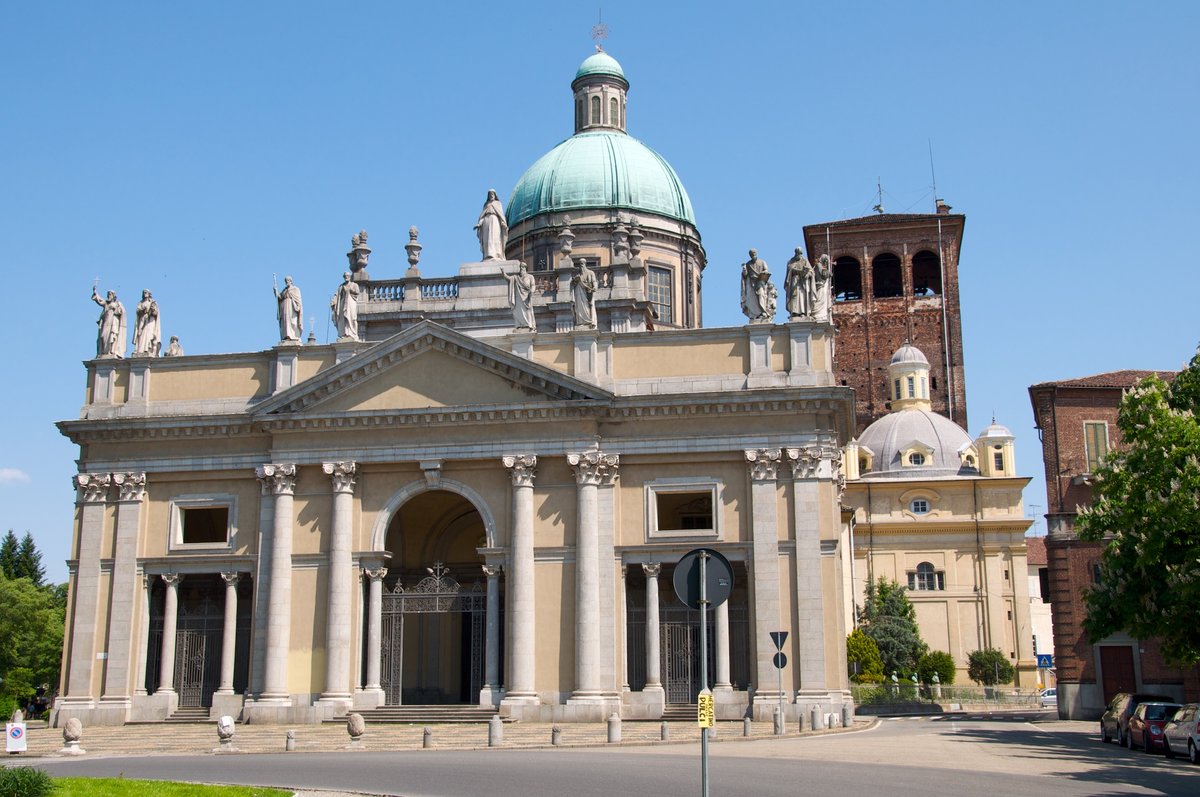

Built on the site of an ancient necropolis and consecrated by St Eusebius himself in 4th century, Vercelli Cathedral has withstood the trials of time, the Gothic invasions, and numerous renovations since. The present structure sits where earlier ones were destroyed, the remnants of those long-past eras entombed within the walls that now stand tall. St Eusebius, the first bishop of Vercelli, built the first church on this site over an ancient necropolis of an earlier era - a practice rooted in the belief that he needed to consecrate ground sacred for other reasons before he could build upon it.
That first church was destroyed during the Gothic invasions of the 5th century. It was replaced by a large basilica in the 9th century. In the 11th century, a major restoration took place inspired by a serious fire that threatened the structural stability of the building. The present campanile dates back to the 12th century. Pellegrino Tibaldi was commissioned in the 16th century to rebuild the cathedral entirely, work that continued until lack of funds brought the project to a halt after eight years.
The present structure, with its five aisles, a transept and imposing portico, was completed in the 18th century, thanks to the work of Benedetto Alfieri and Luigi Barberis. A Chapel housing the relics of St Eusebius was added in the late 19th century. The cathedral today exhibits an important treasury, including the Vercelli Book and the Codex Vercellensis, part of its library.
Sources: Wikipedia, OpenStreetMap, Wikidata, Wikimedia Commons
Written by Nicolo Ciampini
Discuss this with the author and others
No comments yet. Be the first to start the conversation.