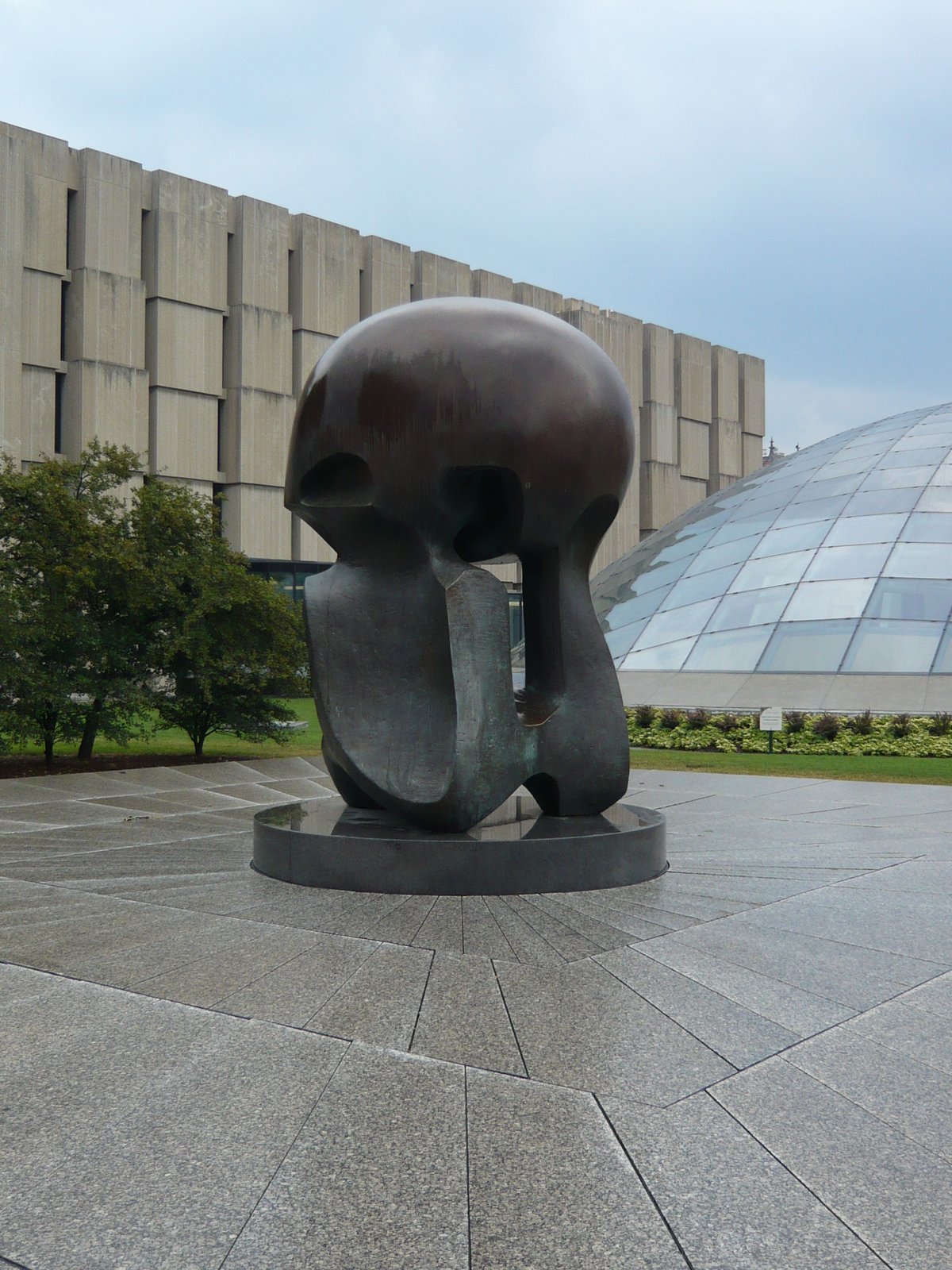

Nuclear Energy is a bronze sculpture by Henry Moore located on the campus of the University of Chicago. It sits on a square, granite paved, concrete platform on Ellis Avenue, between the Max Palevsky West dormitory and the Mansueto Library. The sculpture was commissioned by the B. F. Ferguson monument fund and was erected to celebrate the 25th anniversary of the first human-made self-sustaining nuclear chain reaction, which occurred at Chicago Pile-1 on December 2, 1942.
Four plaques on a nearby granite wall mark the site. The sculpture was unveiled at precisely 3:36 p.m. on December 2, 1967. According to the Smithsonian Institution, the sculpture is 14.0 feet in height and 8 feet in diameter, though the University of Chicago lists its height at 12 feet and the Henry Moore Foundation lists it at 3.66 meters. The site was designated as a National Historic Landmark in 1965 and a Chicago Landmark in 1971.
Moore described the sculpture's shape as resembling a large mushroom or a mushroom cloud, with a top that has a head shape like the top of a skull and a lower part that is more like an architectural cathedral. He noted that the lower part could be seen as a protective form constructed for human beings, while the top represented the destructive side of the atom. This dual nature was intended to express the whole event of the nuclear age in a symbolic way.
The sculpture explores the hopes and fears of the Atomic Age, where the potential for controlled nuclear power or a nuclear holocaust is tied to the historical events of the site. While humanists viewed the model as powerful, nuclear physicists considered it threatening and militaristic. Critics have situated the monument as a marker of the beginning of the nuclear age, praising its ability to make the discovery tangible to the viewer.
Sources: Wikipedia, OpenStreetMap, Wikidata, Wikimedia Commons

Written by Friendly Jane
Discuss this with the author and others
No comments yet. Be the first to start the conversation.