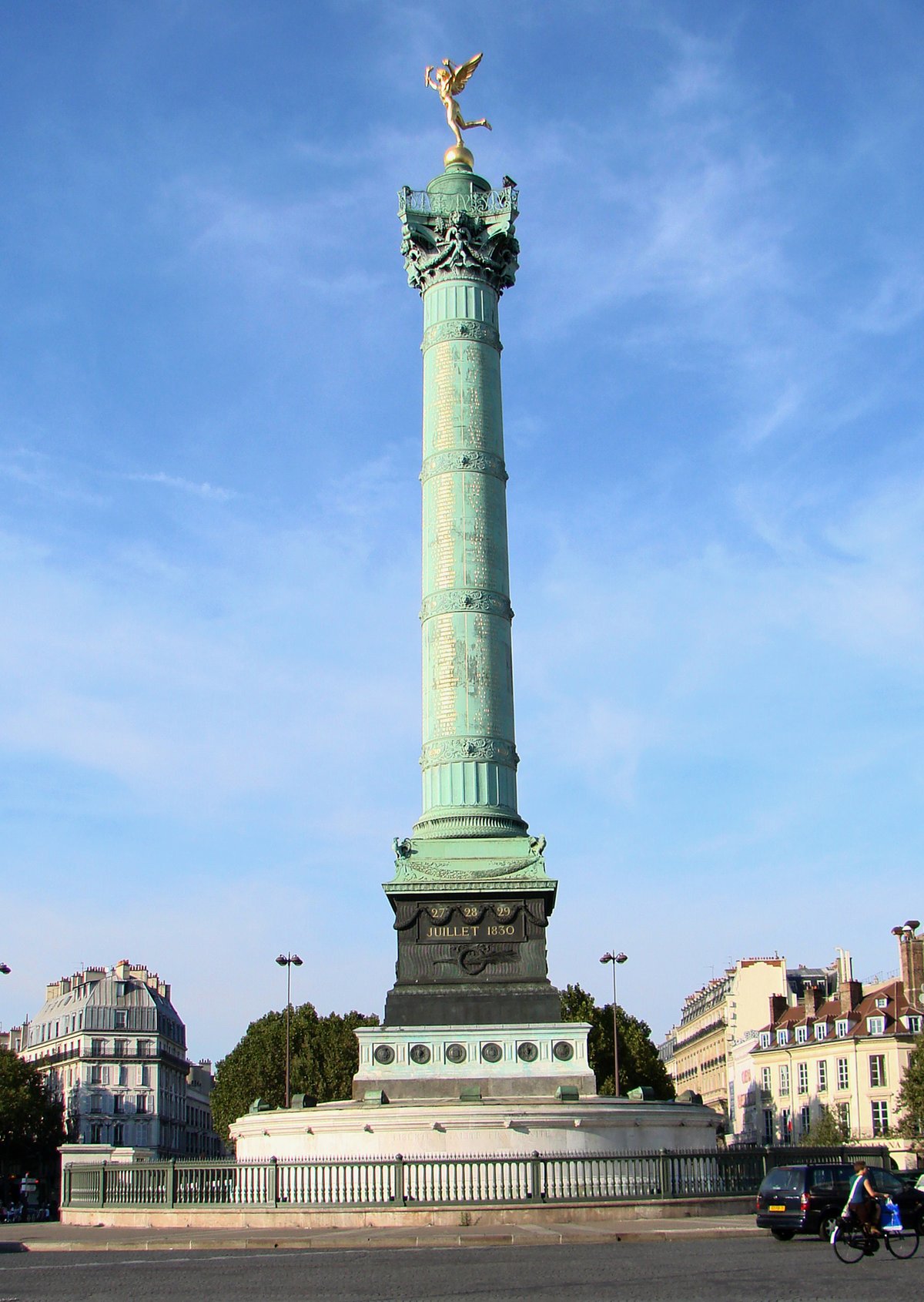

The July Column (French: Colonne de Juillet) is a monument in Paris, France, located in the Place de la Bastille. Commissioned by King Louis- Philippe in December 1830,\ following the July Revolution, it was designed by Jean-Antoine Alavoine and constructed by Joseph-Louis Duc. The monument stands 47 meters high and is made of bronze, with a white marble base and ornamented with bronze bas-reliefs, notably the lion by Antoine-Louis Barye. The July Column was inaugurated on July 28, 1840.
Over 600 victims of the 1830 July Revolution were interred in the monument’s foundation, and an additional 200 victims of the 1848 revolution were later interred. It contains a crypt beneath it that houses the remains of these victims. The monument’s sculpture includes roosters by Barye at the corners, and it is engraved in gold with the names of those who died during the July 1830 revolution. The gilded figure at the top of the column is Augustin’s Génie de la Liberté, representing the 'Spirit of Freedom'.
The statue is nude, star-crowned, and brandishes the torch of civilisation and the remains of his broken chains. The July Column is a historic monument, and it has an official website. Images of the July Column can be found online, including on Insecula.
Sources: Wikipedia, OpenStreetMap, Wikidata, Wikimedia Commons
Written by Nicolo Ciampini
Discuss this with the author and others
No comments yet. Be the first to start the conversation.