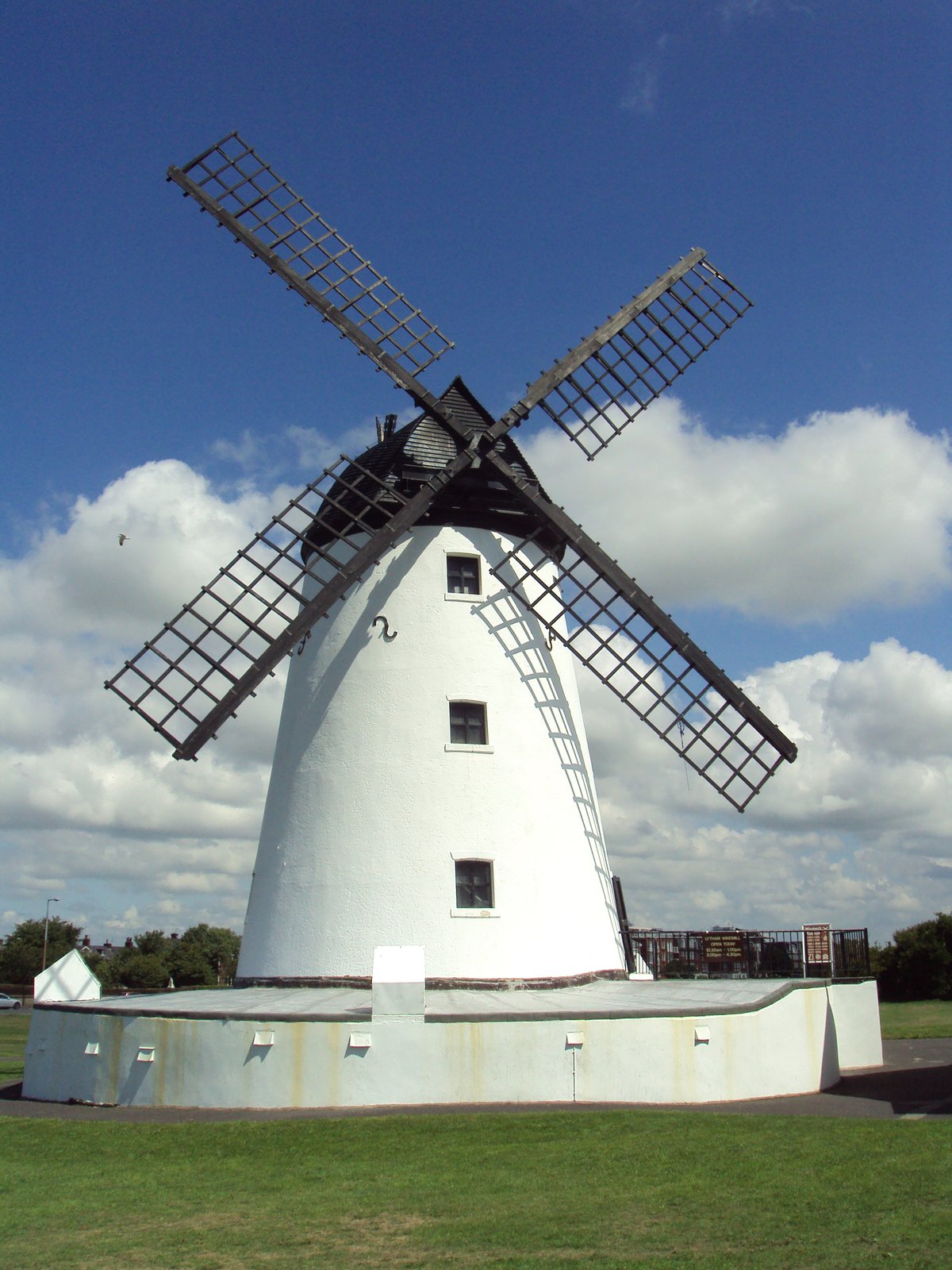
The mill on Lytham Green, in the coastal town of Lytham St Annes, Lancashire, England, is of a type known as a tower mill. It was designed for grinding wheat and oats to make flour or bran. Since commercial milling on the site ceased in 1921, the mill has belonged to the town and is operated by Fylde Borough Council, who open it to the public during the summer. The mill also contains a museum run by the Lytham Heritage Trust, which explains the history and practice of flour milling.
The mill was built around 1805 by miller Richard Cookson on land leased by the local squire. Some of the mill's machinery includes a 150-year-old mainshaft of Baltic oak. The mill was very busy, grinding as much as 80 tonnes of flour a year. In 1919, a high wind caused the mill to be burnt out. The mill's owner, John T. Clifton, donated the gutted building to the town in 1919. The mill was restored and opened to the public by Fylde Borough Council in 1989.
Visitors can see the mill's machinery, including the 150-year-old mainshaft, and learn about its history. The mill's sails were once used for navigation by passing ships.
Sources: Wikipedia, OpenStreetMap, Wikidata, Wikimedia Commons
Written by Nicolo Ciampini
Discuss this with the author and others
No comments yet. Be the first to start the conversation.