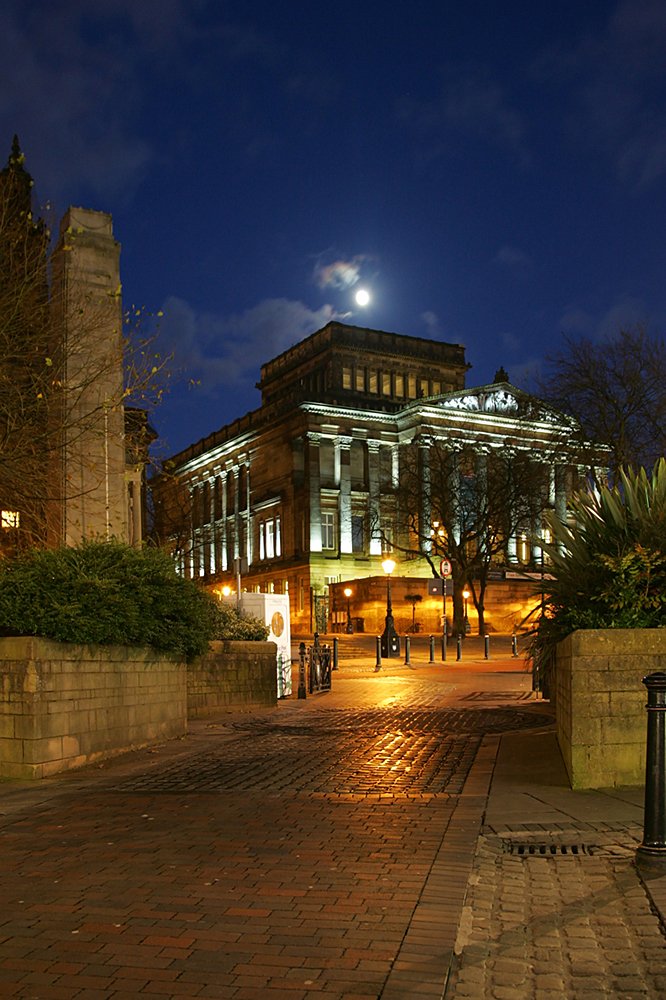

While the rest of Preston favored the Gothic Revival style in the 1880s, local architect James Hibbert chose Neo-Classicism for the town's grand museum and library. He designed the building with a focus on simplicity, symmetry of plan, truthfulness of expression, and refinement of detail. The exterior features a pediment dominated by a sculpture of the Athenian general Pericles, which is considered the principal work of sculptor Edwin Roscoe Mullins. It sits above an inscription stating that on Earth there is nothing great but man, and in man there is nothing great but mind.
Inside, the space opens up into a central hall that rises over 120 feet from the ground floor to the ceiling of the lantern tower. The interior design features classical influences from Ancient Greece, Assyria, and Egypt, including columns and mosaic floors. A Foucault pendulum hangs in the central foyer, swinging through all the floors over a butterfly-shaped plate marked with the hours of the day. This functions as a decorative and reasonably-accurate clock, utilizing the rotation of the Earth.
There is much to see, from over 800 oil paintings to the 13,500-year-old Poulton Elk. This skeleton of an Ice Age elk has two embedded man-made barbed points, making it the earliest relic of human occupation of Lancashire.
The museum is free to enter, though visitors are requested to make a donation if they are able. It recently reopened following a £19 million renovation, and monthly visitor numbers have reportedly more than doubled since its re-opening. It is located in Market Square.
Sources: Wikipedia, OpenStreetMap, Wikidata, Wikimedia Commons
Written by Nicolo Ciampini
Discuss this with the author and others
No comments yet. Be the first to start the conversation.