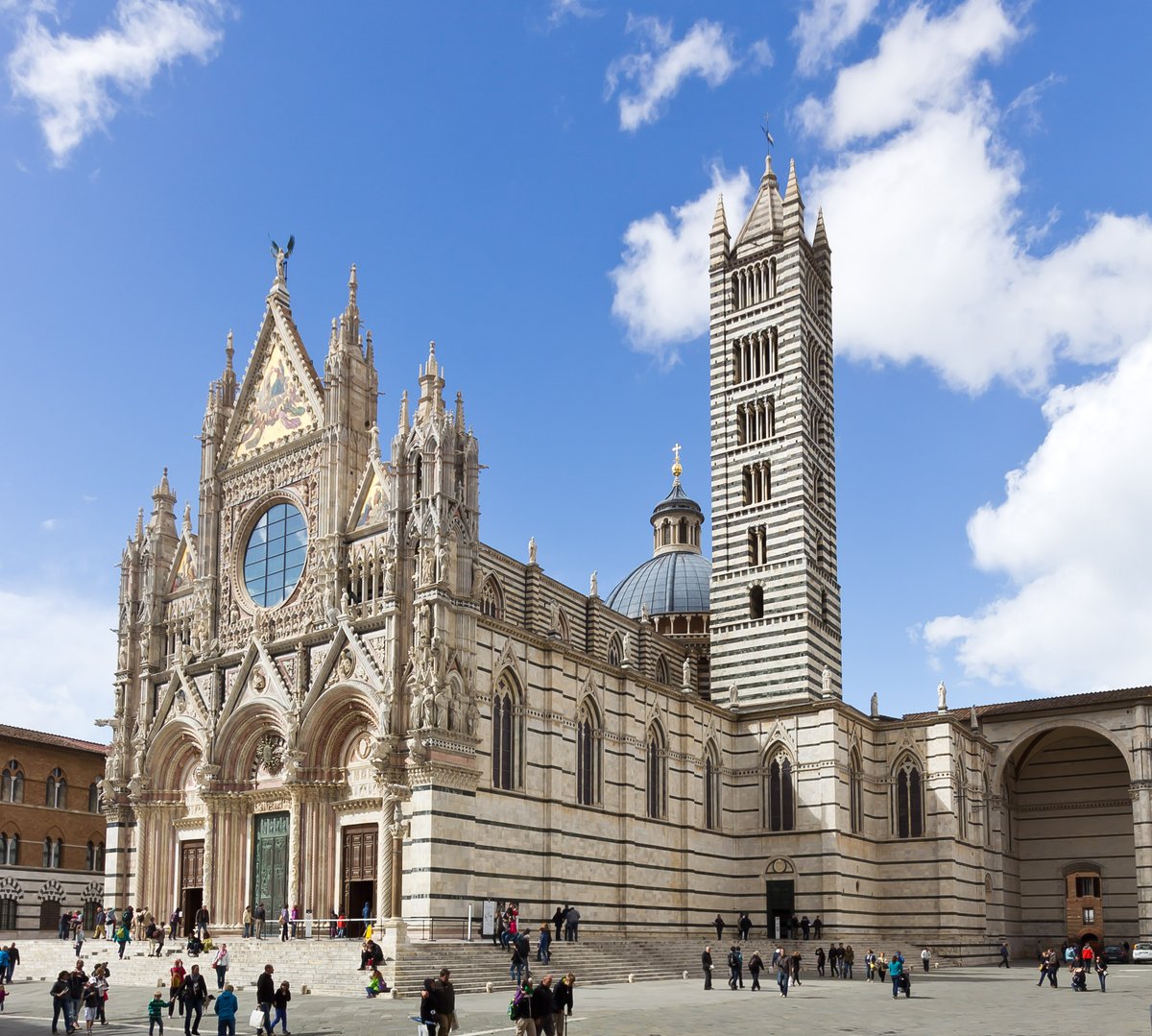

Duomo di Siena, or Siena Cathedral, has been the city's heartbeat for centuries. Constructed between 1215 and 1263, this architectural beauty showcases Tuscan Romanesque style, with a nave separated from the two aisles by semicircular arches. The exterior and interior are a dance of white and greenish-black marble stripes, with a dash of red marble on the façade, a nod to Siena's symbolic colors, black and white, linked to the city's founders, Senius and Aschius.
The dome, completed in 1264, rises from a hexagonal base with six supporting columns. The 12th-century bell tower houses six bells, one cast in 1149. Notable Italian artists such as Nicola and Giovanni Pisano, Donatello, Pinturicchio, Lorenzo Ghiberti, and Bernini contributed to its decoration. For instance, Nicola Pisano crafted the Pu 1268 Pulpit, while Donatello forged the Pulpit Saint John The Baptist 1435. The cathedral’s current form is the result of constant expansion from its earliest days and the contrasting approaches of the masons’ guild and the city's overseers.
Sources: Wikipedia, OpenStreetMap, Wikidata, Wikimedia Commons
Written by Nicolo Ciampini
Discuss this with the author and others
No comments yet. Be the first to start the conversation.