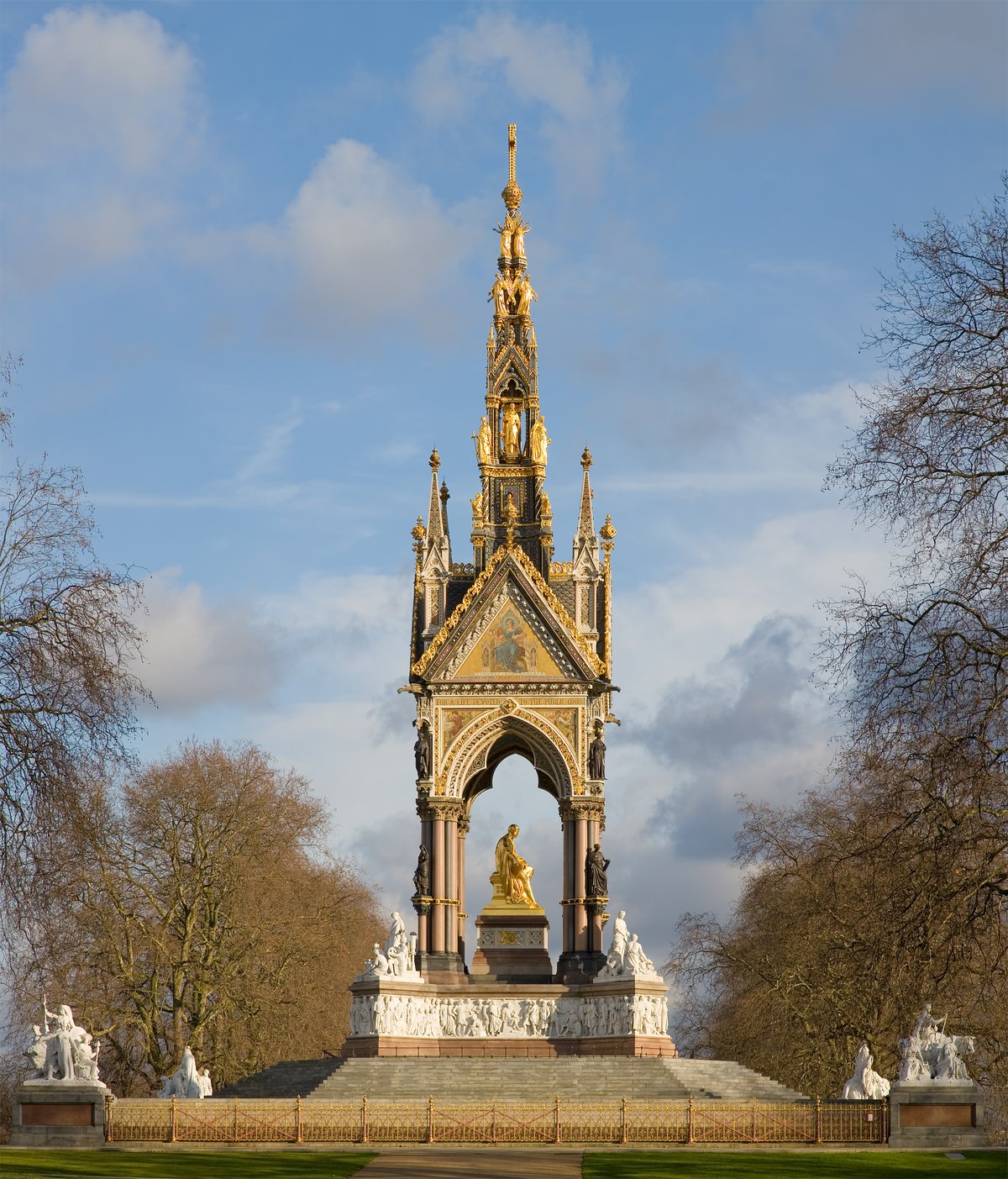
Kensington Gardens, once part of the private gardens of Kensington Palace, are now among the Royal Parks of London and largely open to the public. The gardens are shared by the City of Westminster and the Royal Borough of Kensington and Chelsea and sit immediately to the west of Hyde Park, in west London. The gardens cover an area of 107 hectares (265 acres).
Kensington Gardens were originally the western extent of the neighbouring Hyde Park from which they were originally taken, with West Carriage Drive (The Ring) and the Serpentine Bridge forming the boundary between them. The Gardens are fenced and more formal than Hyde Park. Kensington Gardens are open only during the hours of daylight, whereas Hyde Park is open from 5 am until midnight all year round. Kensington Gardens has been long regarded as 'smart' because of its more private character around Kensington Palace. However, in the late 19th century, Hyde Park was considered more 'fashionable', because of its location nearer to Park Lane and Knightsbridge.
Beginning under Queen Anne, Kensington Gardens was designed by Henry Wise and Charles Bridgeman in order to form a landscape garden, with fashionable features including the Round Pond, formal avenues and a sunken Dutch garden. It was separated from the remainder of Hyde Park in 1728 at the request of Queen Caroline. Bridgeman created the Serpentine between 1726 and 1731 by damming the eastern outflow of the River Westbourne from Hyde Park. The part of the Serpentine that lies within Kensington Gardens is known as 'The Long Water'.
At its north-western end (originally the inflow of the River Westbourne), in an area known as 'The Italian Garden', there are four fountains and a number of classical sculptures. At the foot of the Italian Gardens is a parish boundary marker, delineating the boundary between Paddington and St George Hanover Square parishes, on the exact centre of the Westbourne river. Kensington Gardens were opened to the public in 1841.
Sources: Wikipedia, OpenStreetMap, Wikidata, Wikimedia Commons
Written by Nicolo Ciampini
Discuss this with the author and others
No comments yet. Be the first to start the conversation.