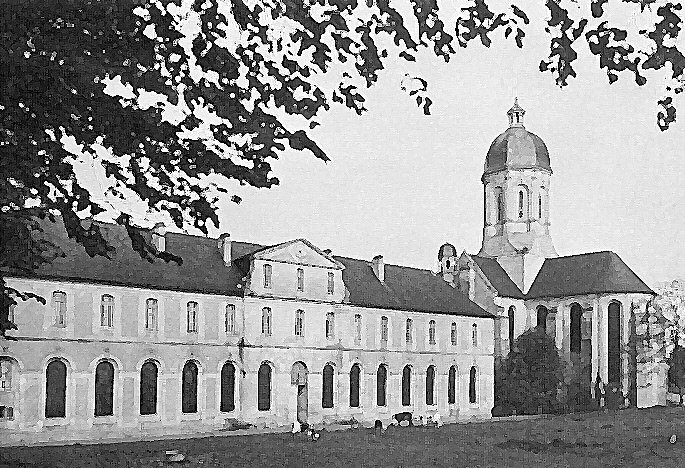

Mondaye Abbey, a French Premonstratensian abbey, is located in the Bessin countryside at Juaye-Mondaye, Calvados, nine miles to the south of Bayeux. When Turstin died in 1200, the bishop of Bayeux established the community under the Rule of St. Augustine. It is the only Premonstratensian house still active in Normandy. In the mid-12th century, a priest named Turstin withdrew to a wooded Norman hill to live as a hermit, where he was quickly joined by a circle of followers.
Turstin's brother-in-law Raoul de Percy donated land for the abbey. In 1210, under the protection of La Lucerne Abbey, the order was incorporated into the order of Saint Norbert. Over the following years, the abbey continued to receive donations from the de Percy and de Vassy families, as well as from lesser nobility and well-to-do farmers. The abbey was ravaged by Richard FitzAlan, 11th Earl of Arundel, in 1389. Mondaye flourished again under the abbacy of Jean Feray (1512-1557).
Its monks attended the university of Caen and included many doctors of theology among them. However, this high period was interrupted by the French Wars of Religion, with the abbey burned, its treasures dispersed and its abbot Julien Guichard killed by Huguenots on 5 September 1564. After the Council of Trent, calm returned and the monastery church was restored thanks to support from Anne de Médavy. In 1631, Claude Leclerc du Tremblay was appointed commendatory abbot by the king and headed the abbey for the next 75 years.
The Lorraine reform revising the Saint Norbert rule and making it stricter and closer to its origins was adopted by Mondaye abbey in 1655. Choosing a prior by the chapter of the congregation partly avoided the disadvantages of a commendatory abbot. In 1859, the Premonstratensian order moved back into the buildings and the community underwent a major phase of expansion and increased their number of parochial missions, preaching tours and retreats. However, a new crisis arose when the authorities of the French Third Republic wished to reduce monks' influence in society in 1880.
Sources: Wikipedia, OpenStreetMap, Wikidata, Wikimedia Commons
Written by Nicolo Ciampini
Discuss this with the author and others
No comments yet. Be the first to start the conversation.