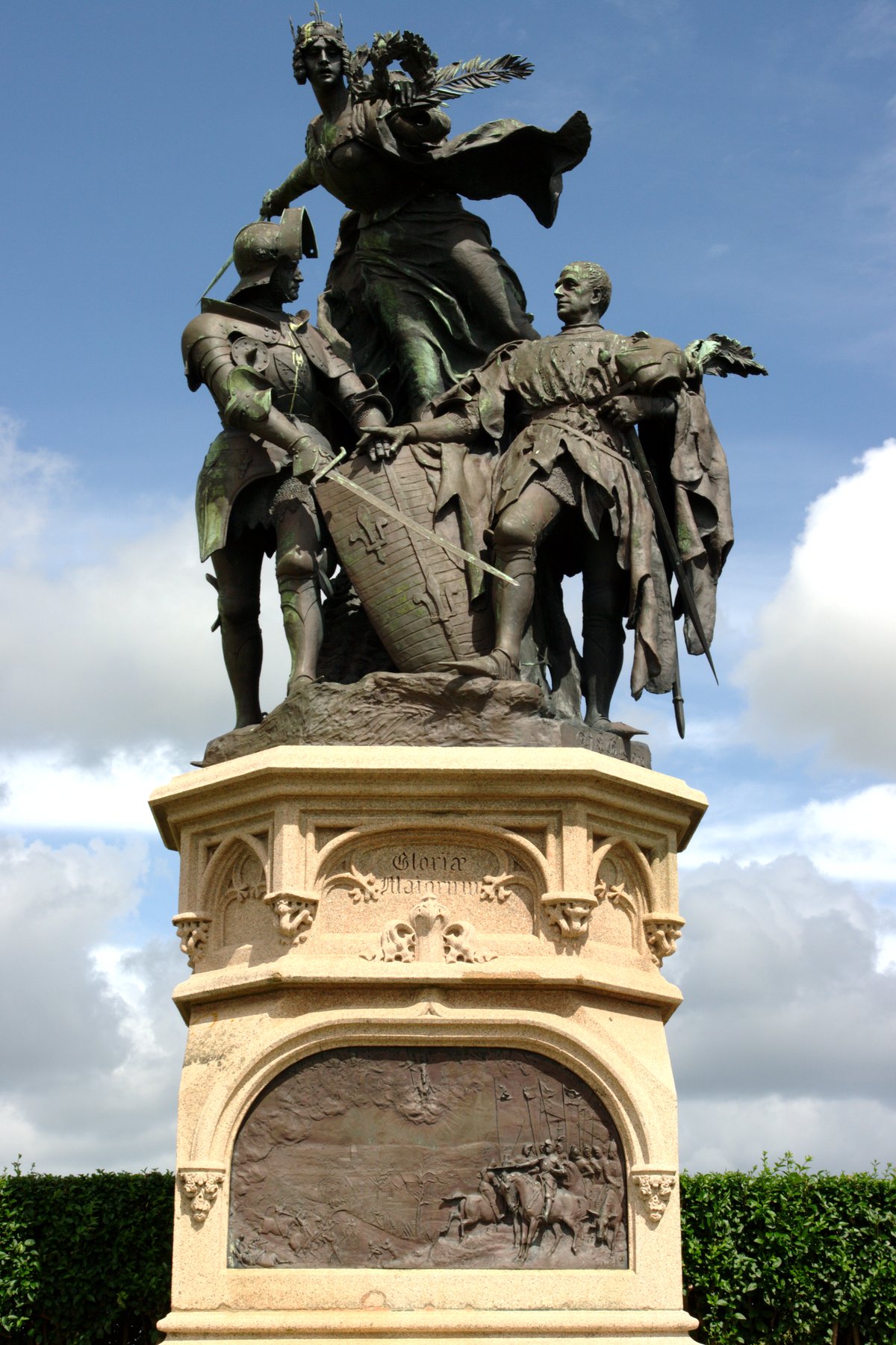

The Monument to the Battle of Formigny, a bronze statue installed on the French commune of Formigny, in the Calvados department, in the Normandy region, is a silent witness to the victory that ended England's occupation of Normandy. The battle took place on April 15, 1450, during the Hundred Years War. The work was created by the French sculptor Arthur Le Duc, who depicted the leaders of Charles VII's French army: the Constable of Richemont and the Count of Clermont, who hold in their left hand a wreath of laurels and a palm, symbols of victory, as well as a sword in their right hand, pointed towards Cherbourg, the next objective of conquest.
The monument and its pedestal are listed as French Historical Monuments. Despite what was considered a dismantling and a storm, the monument was spared because it represented a victory against the English. Other bronze statues were also spared due to the same argument: the statue of the Constable of Richemont in Vannes and the statue of Henri de Guesclin in Caen, both by the same hand, as well as that of Napoléon I in Cherbourg, the work of Armand Le Véel.
Sources: Wikipedia, OpenStreetMap, Wikidata, Wikimedia Commons
Written by Nicolo Ciampini
Discuss this with the author and others
No comments yet. Be the first to start the conversation.