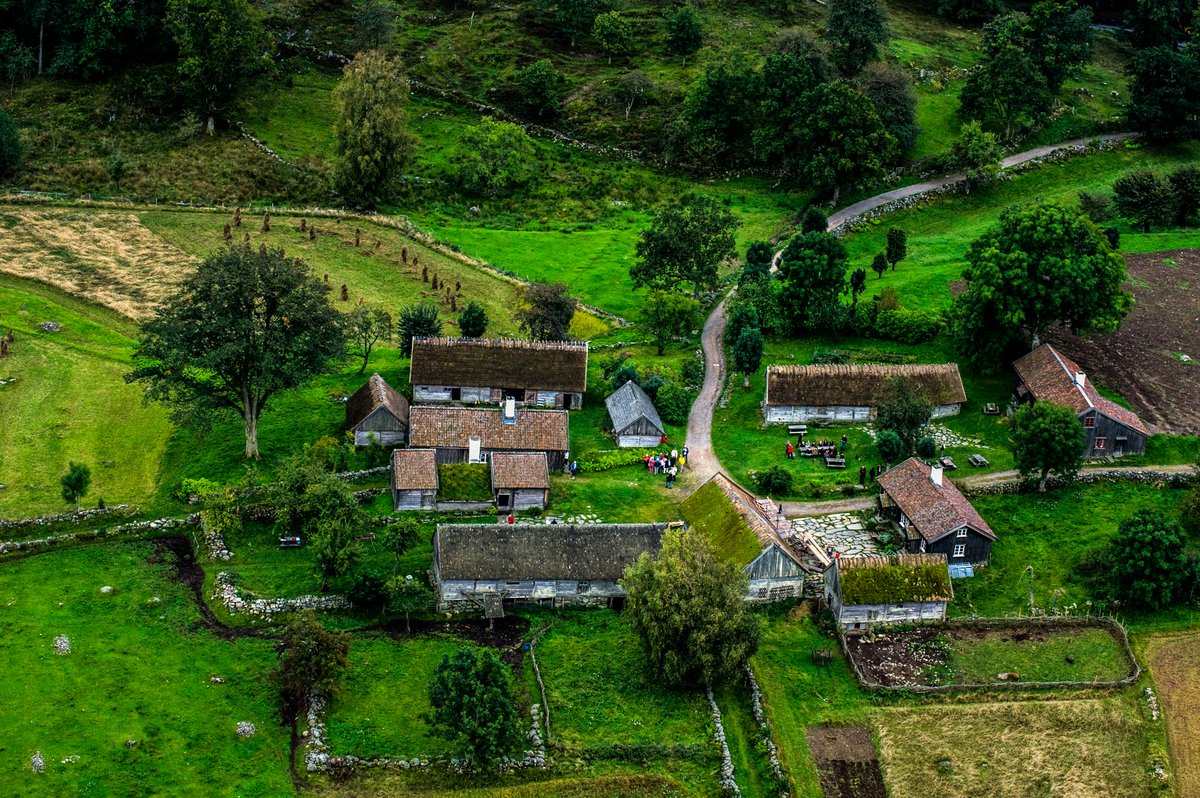

Four farms and eleven buildings make up Äskhults by in Kungsbacka Municipality, Sweden. Known as the byn, it has no current inhabitants but holds a secret. In 1825 and 1864, a massive land swap known as the storskifte and laga skifte took place, changing the map forever. But Äskhults by was swapped in a way that protected its original structures. The four farms - Bengts gård, Jönsas gård, Derras, and Göttas gård - remain in their original locations and provide a glimpse into life in rural Sweden from the 1600s to the 1800s.
The last resident died in 1964, and the buildings were preserved through lobbying during the 1940s and 1950s. Since 1981, Äskhults by has been a building site, and since 2004, it has been a cultural preservation site. Today, visitors can walk through the buildings, some of which have been modernized, and get a glimpse of what life was like in rural Sweden in the past.
Bengts gård, named after riksdagsman Bengt Pehrson, consists of a dwelling house and a barn. The current Bengts gård house was built in 1850. Jönsas gård, named after several generations of Jöns-söner over the 1600s and 1700s, features an original weaving loom. The current Jönsas gård house was moved to Äskhult's by from Timmerås in Förlanda between 1968 and 1970. The 1953 fire destroyed the previous Jönsas gård house. Göttas gård, named in 1755, was bought by Anders Persson from Gödatorp in Gällinge in 1755. Göttas consists of a dwelling house, stall, barn, cellar, 'huggehus' with carpenter's workshop and wood-storage, and has a small fruit orchard.
Sources: Wikipedia, OpenStreetMap, Wikidata, Wikimedia Commons
Written by Nik Frost
Discuss this with the author and others
No comments yet. Be the first to start the conversation.