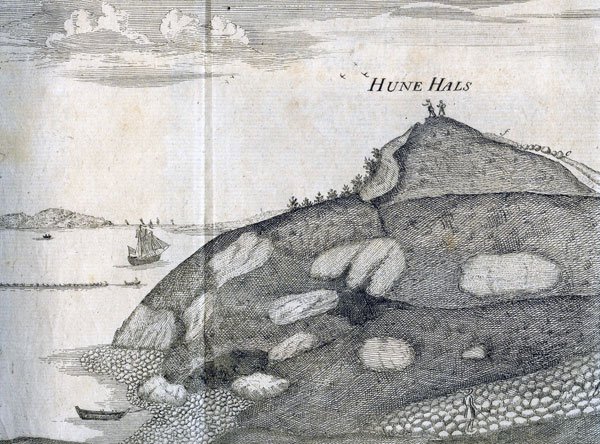

Hunehals is a hill fort ruin in Halland on the eastern side of Kungsbackafjord in Hanhals parish. It is probable that it was built by Greve Jakob of Halland around 1290 during his feuds with Erik Menved over the murder of Erik Klipping. In 1312, Hertig Erik of Sweden likely received Hunehals as a fief from King Håkon, and after his death in 1318, it was inherited by his widow Ingeborg. Following Ingeborg's connection with Duke Knud Porse, unrest arose. In 1327, a Swedish army under the command of Mats Kettilmundsson marched against Hunehals to "level it with the ground."
The final siege of Hunehals occurred in 1328 while Gustaf Tunasson was the lord of Fagranäs. After a brave resistance, he was forced to surrender to the Danes. The Swedish council then decided at a regional day in Södertälje that the fortress should be restored to a defensible state, though this never happened.
In 1366, Kungsbacka slott is mentioned in a letter where Archbishop Niels in Lund acknowledges that Peter Eskilsson managed two farms in "øyø" for King Valdemar at this site. Later, in 1382, Kungsbacka slott is mentioned again when Abraham Brodersson gave his wife Margareta Petersdotter 211 silver marks as a morning gift, for which Queen Margareta left him a portion of Kungsbacka slott as collateral. It has been assumed that the Hunehals fort and Kungsbacka slott were built on the same site.
Sources: Wikipedia, OpenStreetMap, Wikidata, Wikimedia Commons

Written by Nik Frost
Discuss this with the author and others
No comments yet. Be the first to start the conversation.