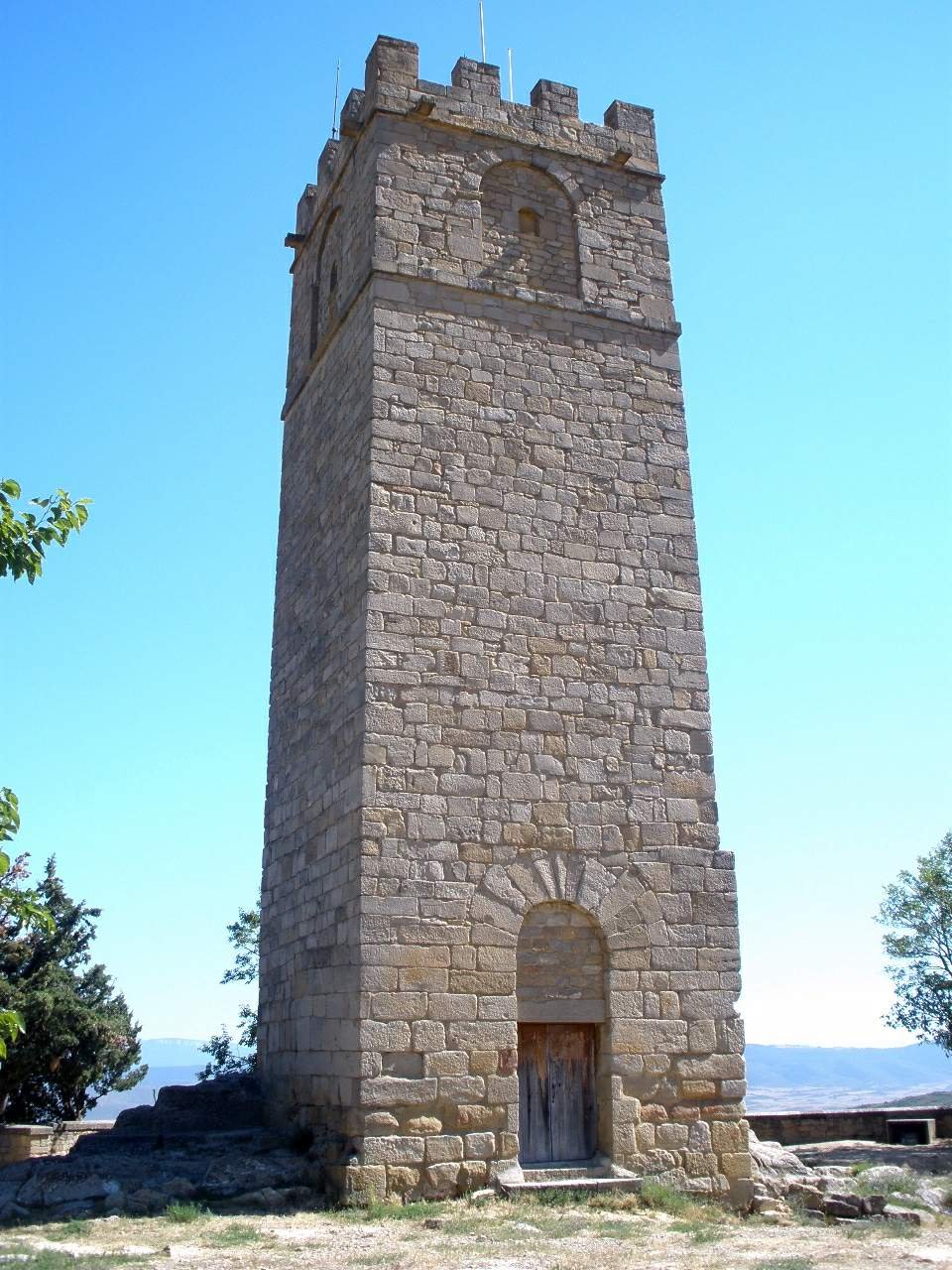

The Castle of Peña Felizana, a 10th-century fortress perched on a natural promontory, has worn many kings’ crowns. Once Sancho Abarca's property, it was later contested by three kingdoms – Navarra, Aragón, and Castile. In 1006, it fell under Sancho the Major's Kingdom of Navarra. One hundred years later, during Ramiro I's reign, it became part of the Kingdom of Aragón. Ramiro II's successor, Alfonso II, was compelled to surrender it to unionists in 1288.
In 1364, Carlos II of Navarra signed accords at Peña Felizana (Acuerdos de Binéfar). During the War of Succession, the castle aligned with Philip of Bourbon’s banner. After the war, the town was granted the privilege to display a lily flower in its coat of arms. The current castle's appearance, likely from the 12th century, boasts a small, irregularly-shaped enclosure with some remaining walls and, at one end, a circular tower with loopholes.
The tower in the center is the keep, square in shape with a side length of 6 meters, built from stone and adorned with battlements. The entrance leads to the courtyard and is a semicircular arch with carved stones.
Sources: Wikipedia, OpenStreetMap, Wikidata, Wikimedia Commons
Written by Nik Frost
Discuss this with the author and others
No comments yet. Be the first to start the conversation.