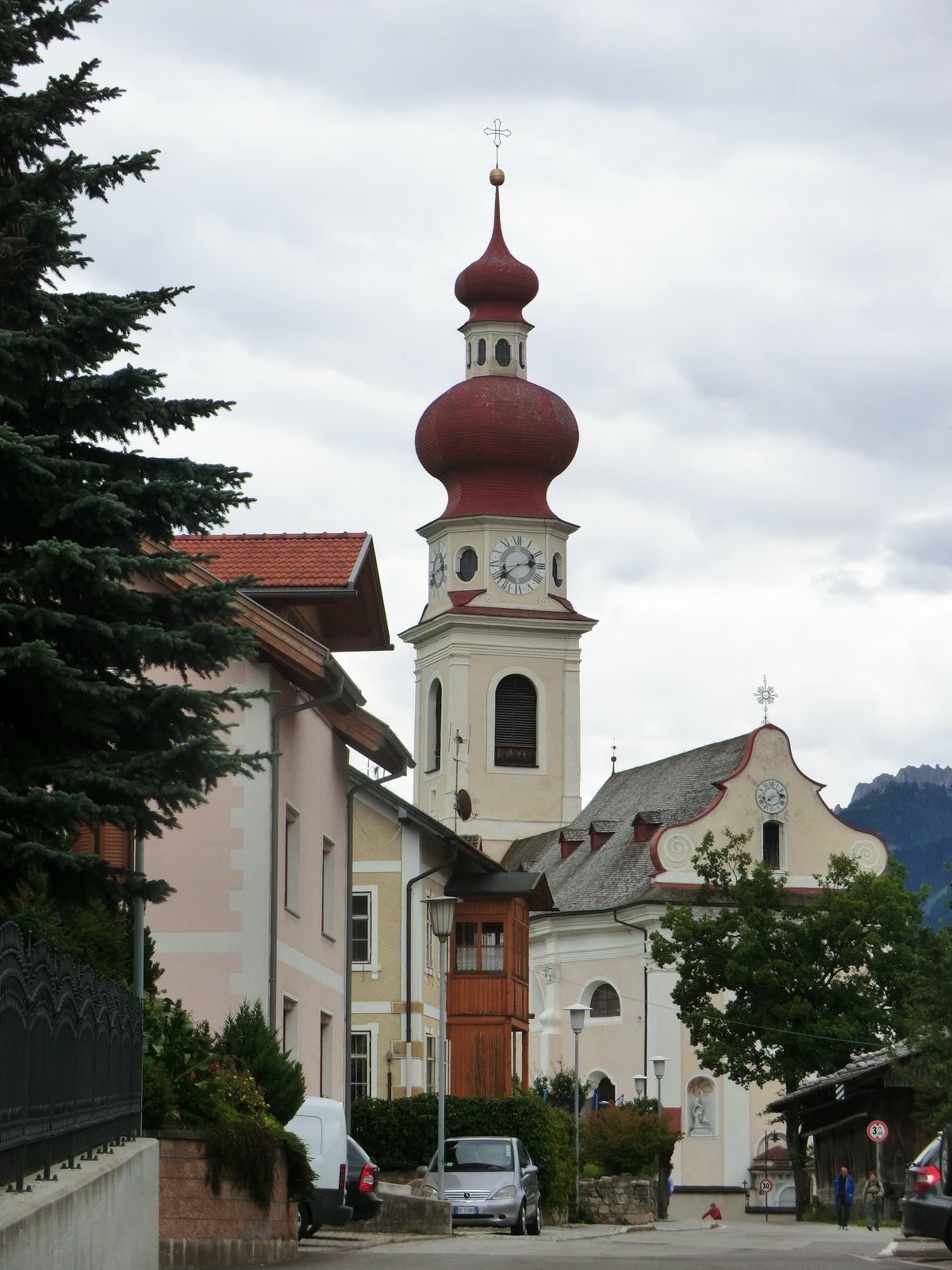

The parochial church of Santo Stefano Protomartire, or simply the church of Santo Stefano, is the parish church of Villabassa, in the province of Bolzano and the diocese of Bolzano-Bressanone; it belongs to the deanery of San Candido-Dobbiaco. The primitive church of Villabassa was attested as parochial in 1225. Around it, Villabassa developed. In 1791, the project for the new Santo Stefano church was assigned to engineer Johann Franz von Pernwerth.
The first stone of the new Santo Stefano church was laid in 1792. The church, built in a late Baroque style, was completed in 1796. The consecration of Santo Stefano church was imparted in 1799. The church presents masterpieces such as the altar major, constituted by columns, the pala d'altare with the Death of San Giuseppe, executed by Martin Knoller, and the frescoes painted by Franz Altmutter depicting Jesus in Emmaus and Saint Stephen before the judges.
Franz Nißl sculpted the saints Gerolamo, Maria Maddalena, Pietro and Davide for Santo Stefano. The campanile of Santo Stefano church has a concerto of 6 bells in Reb3 falling, forged by Luigi Colbacchini of Trento in 1925.
Sources: Wikipedia, OpenStreetMap, Wikidata, Wikimedia Commons
Written by Nicolo Ciampini
Discuss this with the author and others
No comments yet. Be the first to start the conversation.