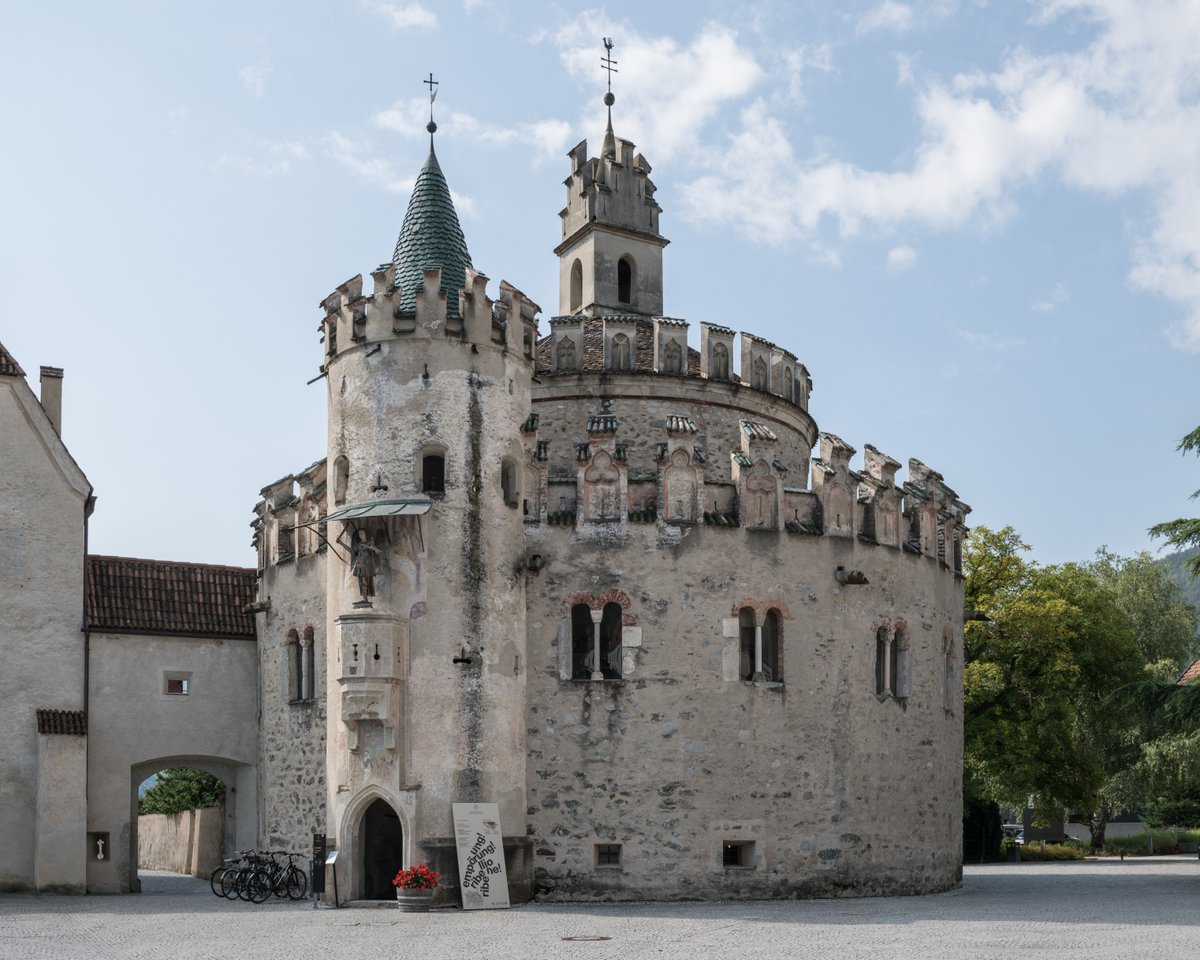

Why choose a spot where the Eisack river makes the land practically uninhabitable? Bishop Hartmann wanted a place for his community to do their penance away from the eyes of the city. He found it at the northern end of the Brixen basin, a spot so rugged and lonely that the records describe it as "wild solitude." It was a strategic choice, really. It was far enough from neighbors to ensure silence, yet positioned perfectly on the important north-south connection and the east-west trade routes from the Pustertal.
Founded in 1142, the monastery started as a mission to fix the spiritual decay of the diocese. Hartmann was a man of habit, and after his time at Klosterneuburg, he wanted to establish a community of regular canons and converses. He was hindered in Brixen by the cathedral chapters, but he succeeded in founding the Neustift Chorherrenstift with the support of Reginbert von Säben, who provided the land and the initial goods. It is a classic case of a well-funded withdrawal from the world.
For a long time, it was a double monastery, though the women eventually vanished by 1300. The grounds were packed with assets - 542 farms by the year 1500. There was even a hospital for pilgrims and the poor, but that was closed sometime between 1463 and 1557. What happened to those massive cells in the basement? They served as dungeon cells after the hospital and its chapel in the Engelsburg ceased their service around 1500. It is a striking change for a place founded on the principle of hospitality.
Neustift received protection from Emperor Friedrich Barbarossa in 1157, and the imperial protection was renewed in 1177. From 1143, the monastery was entitled to the free election of its provost. In 1907, with the founding of the Austrian Congregation of Chorherren, Neustift attained full exemption from the Diocese of Brixen.
Sources: Wikipedia, OpenStreetMap, Wikidata, Wikimedia Commons
Written by Nicolo Ciampini
Discuss this with the author and others
No comments yet. Be the first to start the conversation.