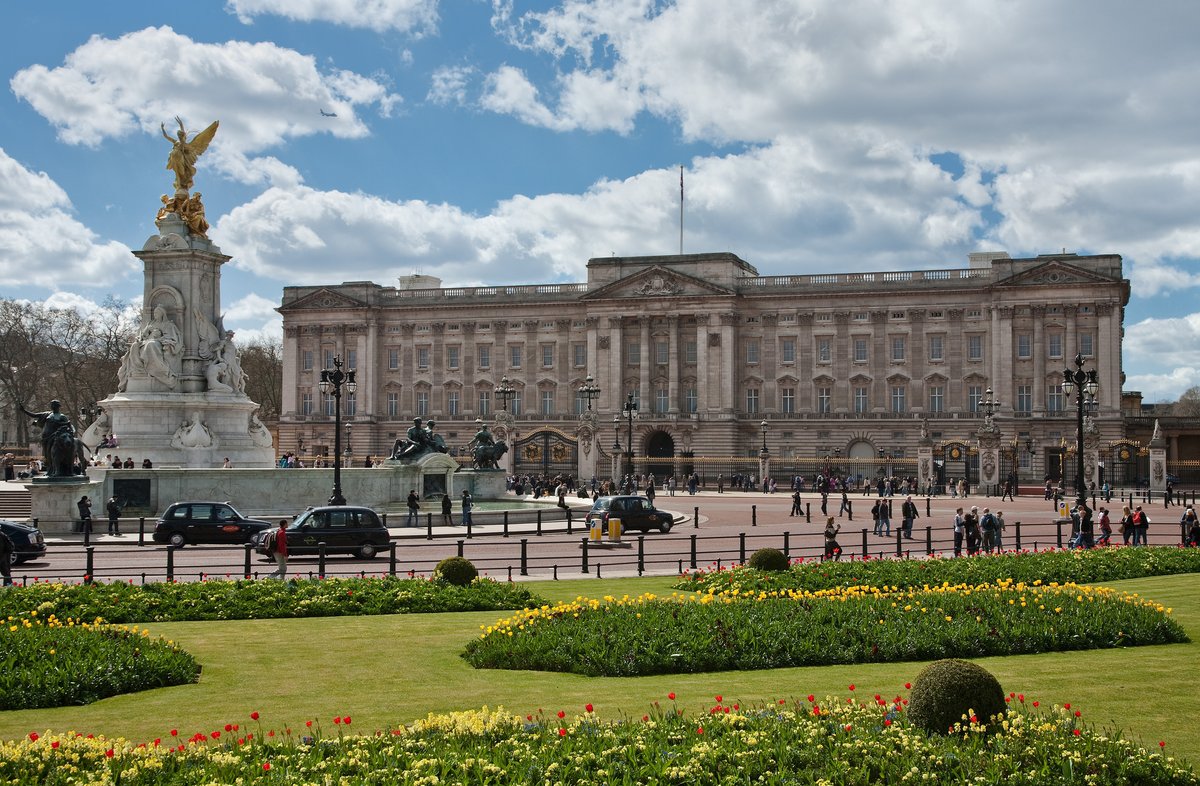
Buckingham Palace, located in the heart of London, has been the official residence of the British monarch since 1837. It is a focal point for national rejoicing and mourning, a testament to its rich history. Before 1624, the site of Buckingham Palace formed part of the Manor of Ebury, the marshy ground being watered by the river Tyburn. In late Saxon times, Edward the Confessor and Edith of Wessex owned the site. After the Norman Conquest, William the Conqueror gave the site to Geoffrey de Mandeville.
Westminster Abbey later owned the site until it was taken by Henry VIII in 1531. From 1536, the site became part of St James’s Palace. In the late 17th century, the freehold was inherited by Mary Davies. Goring House, possibly the first house erected within the site, was built around 1624 by William Blake. George Goring, 1st Earl of Norwich, extended Blake’s house and developed much of today’s garden in the 1630s. Goring House burned down in 1674 and was replaced with Arlington House in 1675.
John Sheffield acquired the lease in 1698 and had Buckingham House built in 1703 for George Goring, 1st Earl of Norwich. Buckingham House was sold by Sheffield’s illegitimate son to George III in 1761 for £21,000. The leasehold on the mulberry garden site, still owned by the royal family, was due to expire in 1774. Queen Charlotte owned Buckingham Palace from 1775. 14 of Queen Charlotte’s children were born in Buckingham Palace. Furnishings were transferred from Carlton House to Buckingham Palace.
The Act of Parliament of 1775 settled Buckingham Palace on Queen Charlotte. Buckingham Palace was initially known as The Queen’s House. French Revolution led to the buying of furnishings for Buckingham Palace. St James’s Palace remained the official and ceremonial royal residence even while Buckingham Palace was being renovated. Buckingham Palace was known as Buckingham Palace from at least 1791. George IV intended to create a small, comfortable home in Buckingham Palace.
John Nash was the architect who helped George IV in the renovation of Buckingham Palace. George IV’s designs for Buckingham Palace led to the removal of John Nash as the architect. Edward Blore was hired to finish the work on Buckingham Palace after the removal of John Nash. William IV never moved into Buckingham Palace, preferring Clarence House. William IV offered to convert Buckingham Palace into a new Houses of Parliament after the Palace of Westminster was destroyed by fire in 1834 but his offer was declined.
Queen Victoria ruled from 1837 to 1901. Queen Victoria became the first monarch to reside at Buckingham Palace in 1837. The building at the core of today’s palace was a large townhouse built for the Duke of Buckingham and Normanby in 1703 on a site that had been in private ownership for at least 150 years. It was acquired by George III in 1761 as a private residence for Queen Charlotte and became known as The Queen’s House. Buckingham Palace served as a private royal residence until the early 19th century when it was enlarged by the architects John Nash and Edward Blore, who constructed three wings around a central courtyard.
Buckingham Palace became the London residence of the British monarch on the accession of Queen Victoria in June 1837. It was occupied by every subsequent monarch until the accession in 2022 of King Charles III, who continues to reside at nearby Clarence House while conducting official duties at the palace. During the Second World War, a German bomb destroyed the palace chapel; the King’s Gallery was built on the site and opened to the public in 1962 to exhibit works of art from the Royal Collection. Today, it stands as a symbol of the British monarchy, a living testament to the nation’s history.
Sources: Wikipedia, OpenStreetMap, Wikidata, Wikimedia Commons
Written by Nicolo Ciampini
Discuss this with the author and others
No comments yet. Be the first to start the conversation.