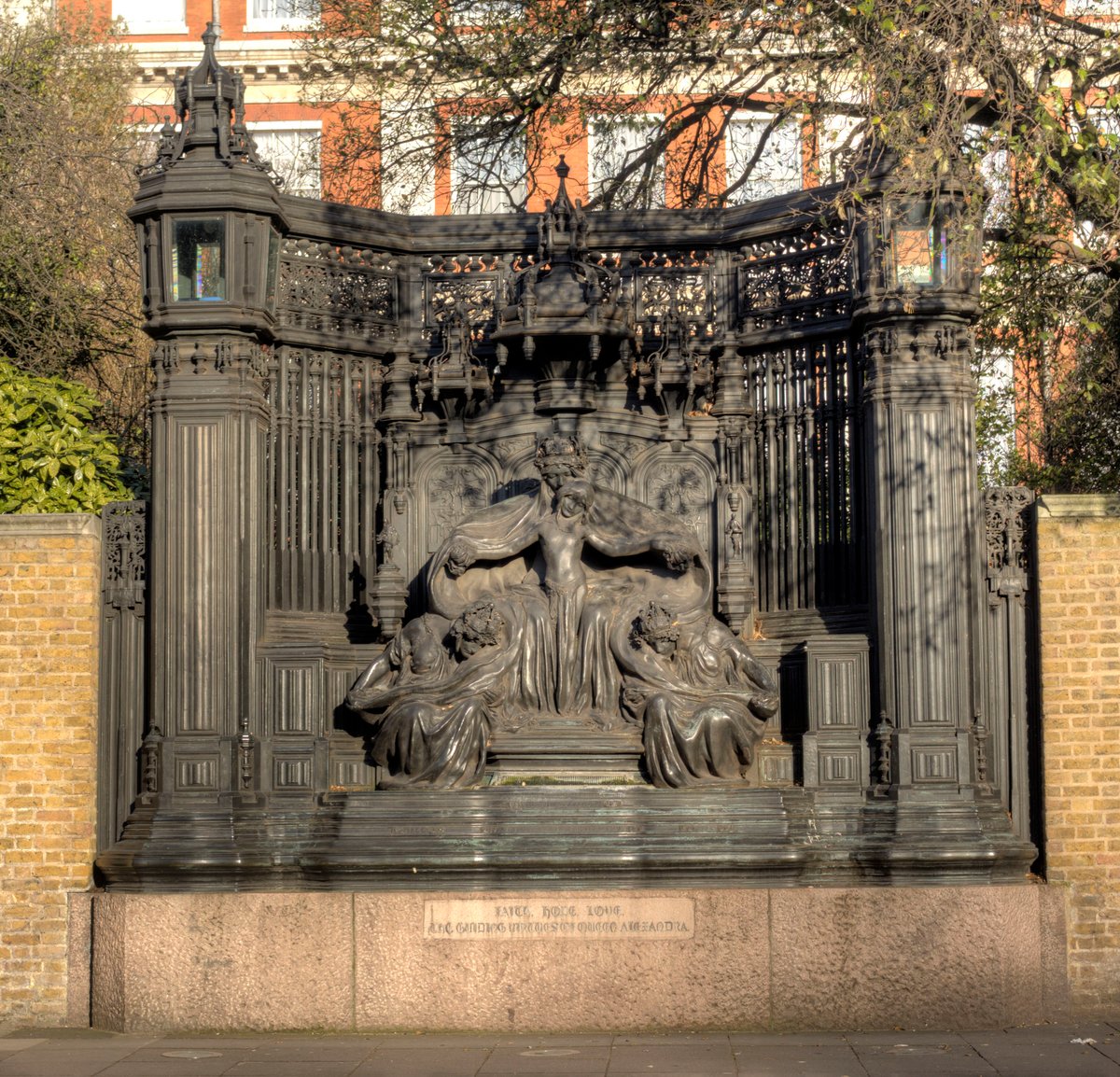

The Queen Alexandra Memorial was executed by the sculptor Sir Alfred Gilbert between 1926 and 1932. This bronze screen, incorporating allegorical figures, is set into the garden wall of Marlborough House and faces St James's Palace. A late example of a work in the Art Nouveau style, it was regarded by the sculptor as his "Swan song".
The central sculptural group represents "Love Enthroned", supported by Faith and Hope on either side. Love is shown directing a Boy sent out across the "River of Life" which springs from beneath Her Throne - symbolizing Queen Alexandra's charity to Children. The water also typifies Her advent to Great Britain from across the water.
The composition is in a style adapted from Perpendicular Gothic architecture, with three buttressed and pinnacled canopies over the figures and linenfold motifs on the screen. Two further allegorical statuettes appear on finials on the throne, that on the left representing Religion and the other without an attribute to help with identification, though Truth has been proposed as its subject.
The memorial was cast by A. B. Burton at the Thames Ditton Foundry and was unveiled on 8 June 1932 by George V. At the unveiling ceremony the memorial was blessed by the Archbishop of Canterbury, Cosmo Gordon Lang, and the choir of the Chapel Royal gave the first performance of Queen Alexandra's Memorial Ode, which had been composed for the occasion by the Master of the King's Music, Sir Edward Elgar, with lyrics by the Poet Laureate, John Masefield.
On the following day Gilbert received his knighthood from the King at Buckingham Palace. The two main inscriptions read QUEEN ALEXANDRA/ 1844 A TRIBUTE TO THE EMPIRE'S LOVE 1925 on the bronze base and FAITH, HOPE, LOVE./ THE GUIDING VIRTUES OF QUEEN ALEXANDRA on the granite base below. The memorial was Gilbert's last completed public artwork, as he died in November 1934.
Sources: Wikipedia, OpenStreetMap, Wikidata, Wikimedia Commons

Written by Nicolo Ciampini
Discuss this with the author and others
No comments yet. Be the first to start the conversation.