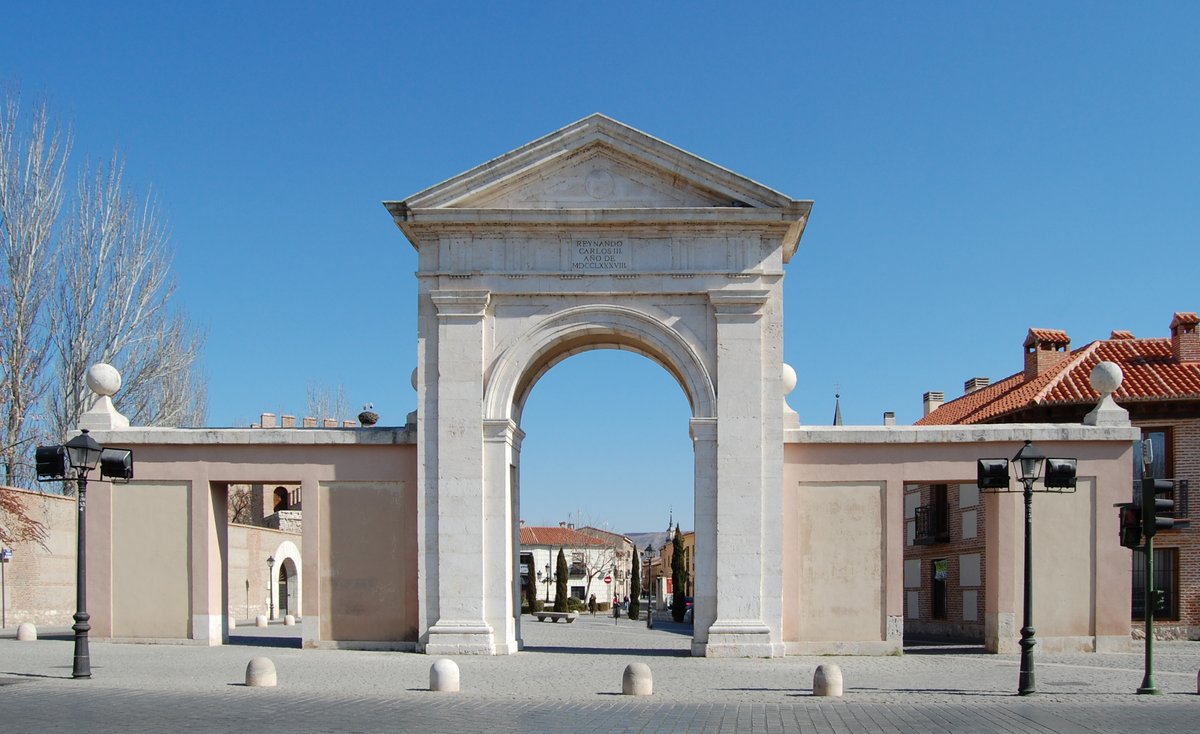

The current Puerta de Madrid, built in 1788, replaced a medieval gate in the old fortified wall of the city due to its narrow and bow-shaped structure, making access difficult. Archbishop of Toledo, Most Excellent Lord D. Francisco Antonio Lorenzana, paid for the construction during the reign of Charles III. Architect Antonio Juana Jordán led the construction, and the design was neoclassical, featuring a triangular pediment and inscriptions on both sides.
On the city side (east), the inscription reads: ‘At the expense of the Archbishop of Toledo, the Most Excellent Lord D. Francisco Antonio Lorenzana’. On the outer side (west), the inscription reads: ‘Reigning Charles III. Year MDCCXXXVIII’. The space behind Puerta de Madrid was previously known as Plaza de la Cebada, now Plaza Puerta de Madrid, where four major streets converge: Cardenal Sandoval y Rojas, Cardenal Cisneros, Andrés Saborit, and Avenida de Madrid.
Puerta de Madrid is not to be confused with Madrid's other grand gate, Puerta de Alcalá, built in 1778. It is rumored that a silent procession of books was the true purpose of Puerta de Madrid, a testament to Alcalá’s status as a University town.
Sources: Wikipedia, OpenStreetMap, Wikidata, Wikimedia Commons
Written by Nik Frost
Discuss this with the author and others
No comments yet. Be the first to start the conversation.