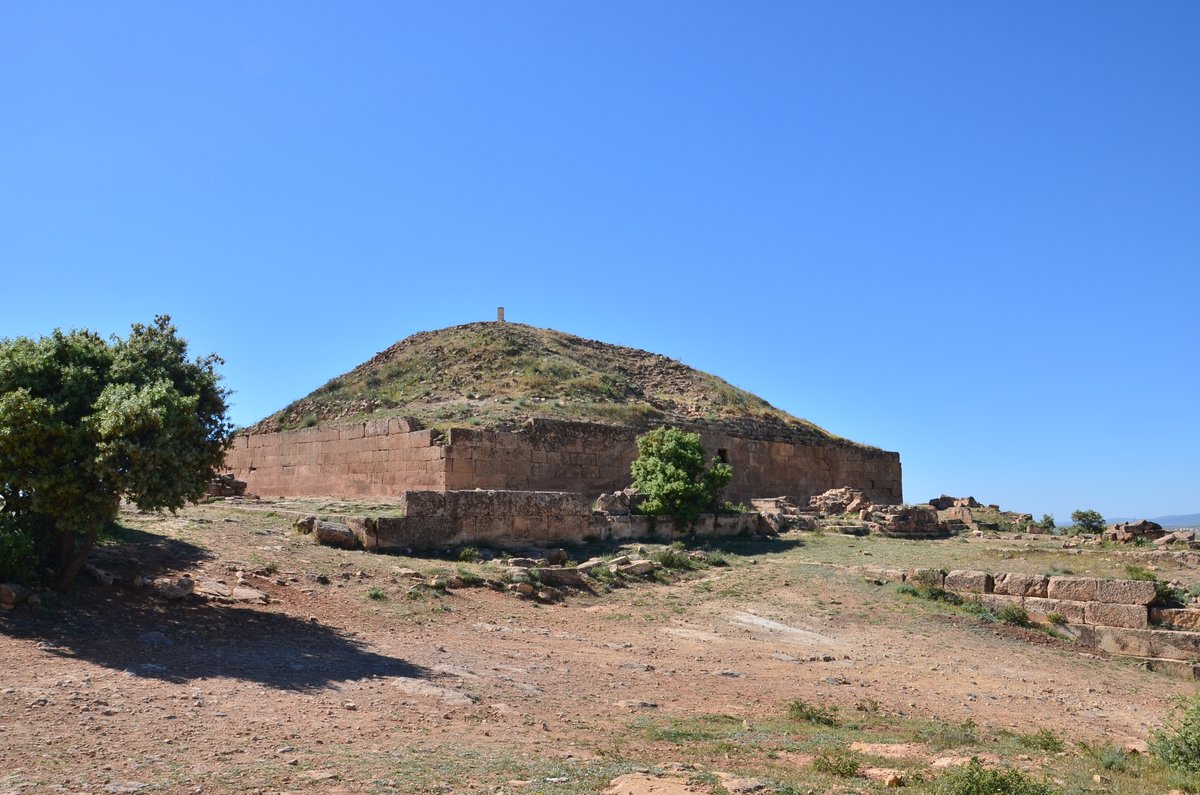

Nestled amongst the rugged peaks of Jabal Lakhdar and Jabal Arawi, south of the captivating city of Tiaret, dwelve thirteen entrancing Jedars. Born from the soul of the Berber people, these tombs earned their name from the Arabic word 'jidār', meaning 'wall'. Scholars claim they were built around the late antiquity (4th–7th centuries CE) as a testament to the Romano-Berber Kingdom of Ouarsenis. Similar in nature are smaller Berber tombs, known as bazinas.
Many, if not all, Jedars present an ethereal courtyard, a square layout with a gentle curve on the eastern side. The grander Jedars reveal within, a sanctuary believed to foster dreams of prophecy during sleep. The Jedars of Jabal Lakhdar, the eldest among them, bear cryptic inscriptions etched into their walls, nearly illegible now. The most impressive jedar at Ternaten is the only one in that group to remain half-preserved, displaying its epigraphy and iconography.
Standing tall with a 46 m. body and reaching heights of up to 4 m, the tombs stretch towards the heavens. Their pyramidal crowns, once towering up to 13 m, were constructed in a series of small, enchanting steps, approximately 0.2-0.25 m. in height. Plundered for centuries, the Jedars now lie shrouded in decay. Stones for their construction were quarried from the local limestone and sandstone, lovingly recycled from nearby ancient settlements and necropolises.
Most of the Jedars were crafted using the ancient art of dry stone construction, with lime mortar sparingly used. These enchanted creations are thought to symbolize the rise of a new magical elite, born during the twilight of the Roman Empire. Some propose that the Jedars were erected as a grand declaration of power.
Sources: Wikipedia, OpenStreetMap, Wikidata, Wikimedia Commons
Written by Mutabor
Discuss this with the author and others
No comments yet. Be the first to start the conversation.