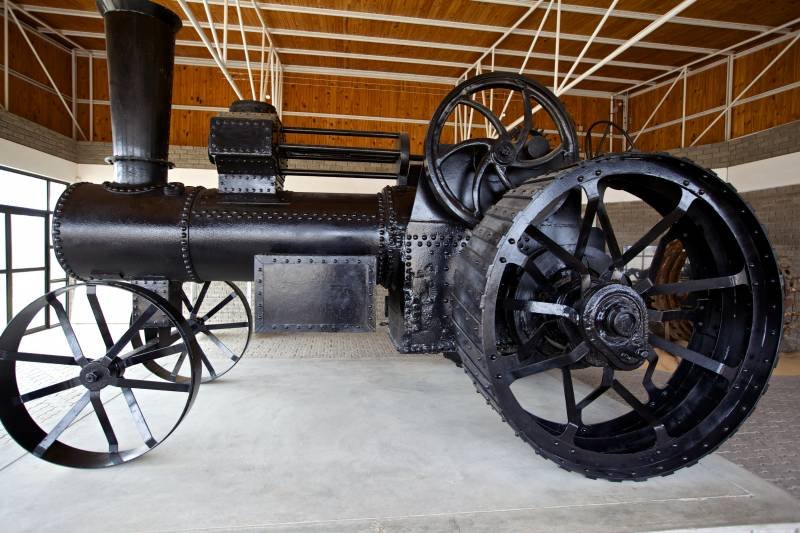

Martin Luther is an 8 NHP Compound J & H McLaren steam-driven traction engine built in Leeds in November 1895. It arrived in Namibia to perform a task of necessity, serving as a road locomotive for freight service between Swakopmund and the interior of the country.
During the colonial era, ox wagons struggled to reach the interior because the route had insufficient grazing for the oxen due to droughts and seasonal conditions, and a great many oxen died along the way. To solve this, First Lieutenant Edmund Troost purchased the traction engine - weighing 280 cwt (ca. 14 tonnes) - and had it shipped from Hamburg to Swakopmund.
The journey from the ship to the town of Swakopmund was a slow struggle. The engine sank in sand almost every 50 metres, requiring enormous quantities of water while an American and a Boer drove it. In early 1897, due to incorrect handling, the engine ground to a halt about 4 km outside of Swakopmund and was abandoned there.
Local resident Max Rhode is said to have remarked in a gathering at the Bismarck Hotel that the steam ox is called Martin Luther because it can say - "Here I stand, I can do no other". Today, the engine is preserved under a protective house, having been restored in 1973 and again between 2000 and 2004 to protect it from the frequent mists of Swakopmund.
Sources: Wikipedia, OpenStreetMap, Wikidata, Wikimedia Commons



Written by Mutabor
Discuss this with the author and others
No comments yet. Be the first to start the conversation.