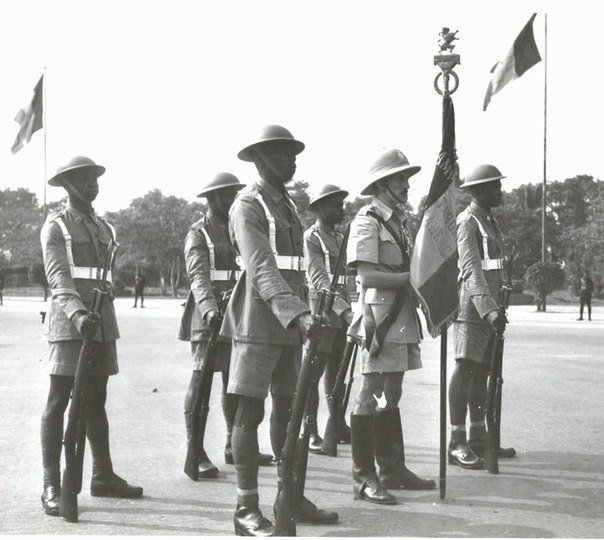

The Force Publique (French: Force Publique; Dutch: Openbare Weermacht) was the military of the Congo Free State and the Belgian Congo from 1885 to 1960. It was established after Belgian Army officers traveled to the Free State to found an armed force in the colony on the orders of Leopold II of Belgium. From 1885 to 1908, the officer corps consisted of hundreds of Belgians and dozens of Scandinavians, with smaller numbers recruited from nations including Italy and Switzerland. By 1900, the Force Publique numbered 19,000 men, with officers of the force being entirely European.
Serving under these European officers was an ethnically mixed African soldiery. Many were recruited or conscripted from warrior tribes in the Upper Congo, while others were mercenaries drawn from Zanzibar and West Africa. The force was tasked with defending Free State territory and internal pacification. In the 1890s, the Force Publique defeated African and Arab slavers during the Congo Arab war, and in 1896, it won a major victory over the Rwandan royal army at the Battle of Shangi.
Under Leopold II, the Force Publique was described as an exceptionally brutal army. One major purpose of the Force was to enforce rubber quotas and other forms of forced labour. Armed with modern weapons and the chicote - a bull whip made of hippopotamus hide - soldiers of the Force Publique often took and mistreated hostages. Reports from foreign missionaries and consular officials detail instances where Congolese men and women were flogged or raped by soldiers. There is evidence, including photographs, that soldiers cut off human hands as trophies or as punishment for parents viewed as not working hard enough on rubber plantations.
By 1908, the force began to rely more heavily on Belgian officers and native Congolese soldiers as white and black foreign mercenaries were phased out. The Force Publique was eventually renamed to the Congolese National Army in July 1960 after Congo gained independence from Belgian colonial rule. Today, the Mémorial aux anciens combattants de la Force Publique commemorates those who served in various campaigns, including victories at Tabora, Redjaf, Asosa, Gambela, and Saïo, as well as actions in Birmanie.
Sources: Wikipedia, OpenStreetMap, Wikidata, Wikimedia Commons
Written by Mutabor
Discuss this with the author and others
No comments yet. Be the first to start the conversation.