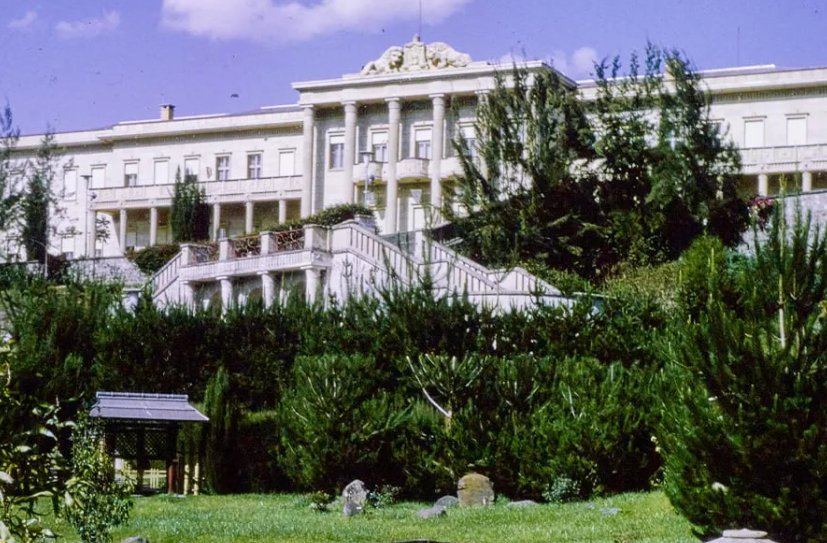

In 1955, the Jubilee Palace was built to mark the Silver Jubilee of Emperor Haile Selassie. After a coup attempt at the Guenete Leul Palace in 1960, the Emperor made the Jubilee Palace his main residence, though the seat of government remained at the Imperial Palace. In 1957, the building was known as the Ministry of Imperial Court, also known as the Ye Gebi Ministry.
Between 1966 and 1967, the palace was expanded and doubled in size. It served as a venue for state ceremonies involving visiting heads of state, state banquets, and receptions. Following the 1974 coup d'état, the building underwent a significant transition in purpose and name.
In September 1974, ten low-ranking military officers appeared before the Emperor in the palace library and read him the statement of the Derg, which officially removed him from the throne. The Derg renamed the building the National Palace and used it for state ceremonies. During this period, they added a swimming pool to the grounds.
With the fall of the Derg and the proclamation of the Federal Republic, the National Palace became the official residence of the president of the Federal Democratic Republic of Ethiopia. The president uses the palace for official functions and ceremonial roles. In 2019, the government announced intentions to build a new official residence, while the National Palace inaugurated a museum and continued to house the president.
Sources: Wikipedia, OpenStreetMap, Wikidata, Wikimedia Commons
Written by Mutabor
Discuss this with the author and others
No comments yet. Be the first to start the conversation.