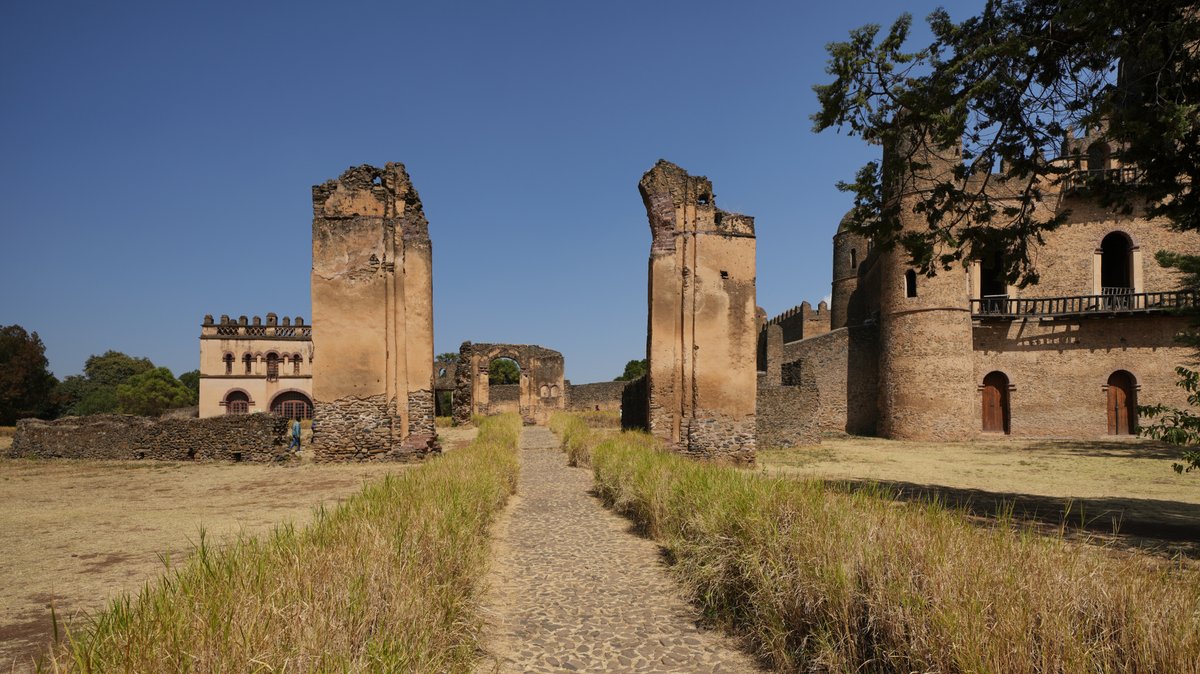

The Fasil Ghebbi is a fortress located in Gondar, in the Amhara Region of Ethiopia. Founded in the 17th century by Emperor Fasilides, it served as the home of Ethiopian emperors. The complex features unique architecture showing diverse influences including Portuguese, Hindu, and Arab characteristics. Because of its historical importance, the fortress was inscribed as a UNESCO World Heritage Site in 1979. The name Ghebbi is an Amharic word for a compound or enclosure.
The complex includes Fasilides' castle, Iyasu I's palace, Dawit III's Hall, Empress Mentewab's castle, a chancellery and library from Yohannes I, a banqueting hall from the emperor Bakaffa, stables, and three churches: Asasame Qeddus Mikael, Elfign Giyorgis and Gemjabet Mariyam. The buildings are constructed of brown basalt with ornaments of local wine-coloured tuff. In 2025, the Fasil Ghebbi underwent preservation efforts.
Emperor Fasilides broke with the tradition of traveling while ruling by founding the city of Gondar as his capital. He ordered the construction of the Fasil Ghebbi, which was later expanded by emperors such as Yohannes I, Iyasu I and Dawit III. According to a Yemeni ambassador who visited in 1648, the architect of Fasilides' edifice was an Indian named Abdal Kerim. The Royal Chronicles report that the edifices of Yohannes I and Iyasu I were built by an Ethiopian architect named Walda Giyorgis. Manual labor was primarily supplied by the local Ethiopian Jews, particularly the Kayla clan, who worked as masons, metalsmiths and carpenters.
Sources: Wikipedia, OpenStreetMap, Wikidata, Wikimedia Commons
Written by Mutabor
Discuss this with the author and others
No comments yet. Be the first to start the conversation.