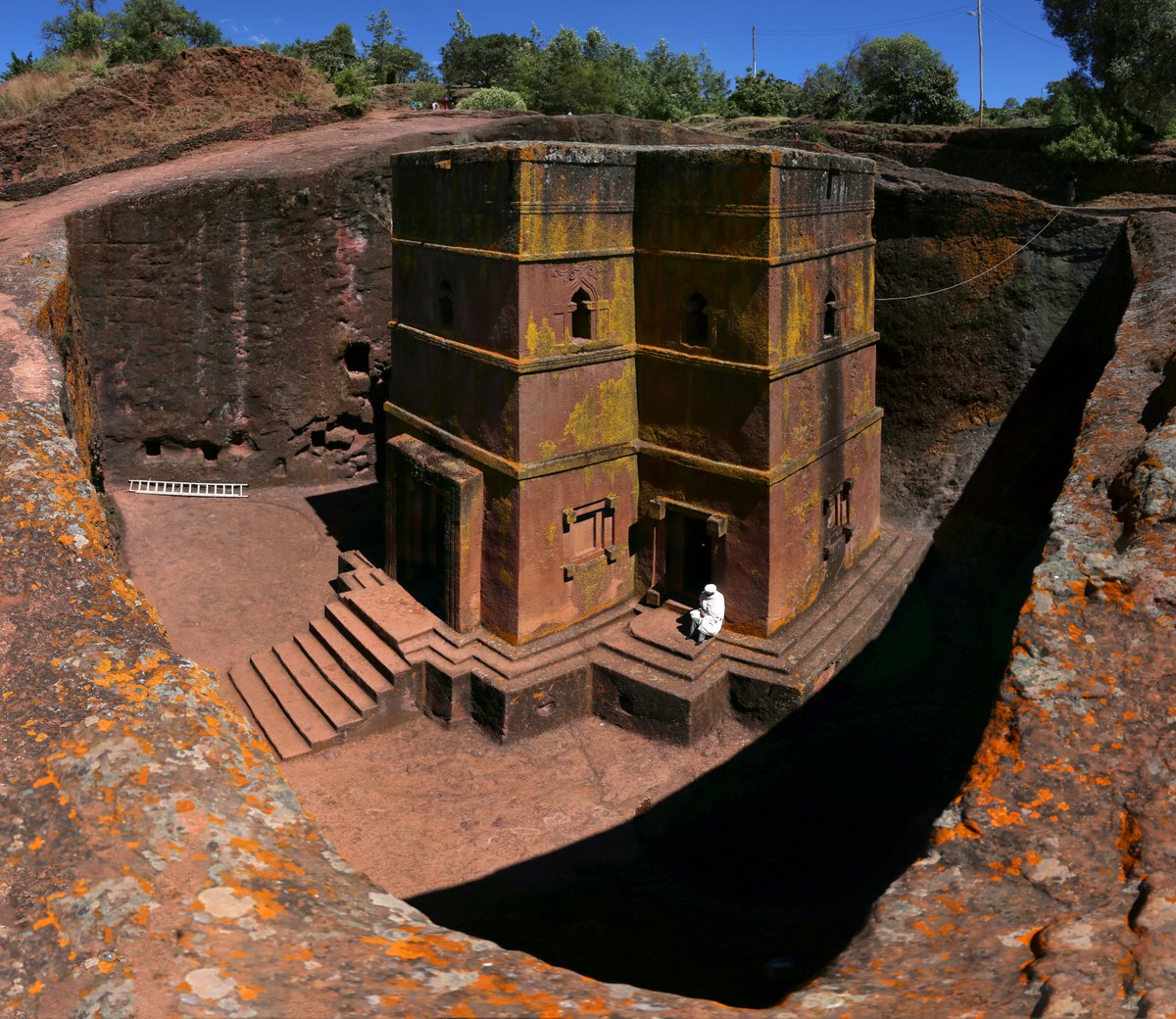

The Church of Saint George (Betä Giyorgis) is one of eleven rock-hewn monolithic churches in the town of Lalibela, in the Amhara Region of Ethiopia. Originally named Roha (Warwar), the historical and religious site was named Lalibela after the King Gebre Mesqel Lalibela of the Zagwe dynasty, who commissioned its construction. The church is carved from volcanic tuff and is dated to the late 12th or early 13th century AD, making it among the last built of the eleven churches in the area.
King Gebre Mesqel Lalibela sought to recreate Jerusalem in the landscape, structuring the churches into two groups representing the earthly and heavenly Jerusalem. Located between these groups is a trench representing the River Jordan. The church itself stands in an artificial trench, with dimensions of 25 meters by 25 meters by 30 meters. A small baptismal pool is located outside the church. According to Ethiopian cultural history, the king had a vision in which he was instructed to construct the church by Saint George and God.
On first approach, the site appears inaccessible with sheer drops on every side and no access bridge. It is accessed via a very narrow man-made canyon that spirals downwards and changes to a tunnel close to the church to conceal its presence. The hollowed interior contains a simple shrine to St. George and, behind a curtain forbidden to view apart from priests, lies a replica of the Ark of the Covenant. The church is part of the UNESCO World Heritage Site Rock-Hewn Churches, Lalibela.
Sources: Wikipedia, OpenStreetMap, Wikidata, Wikimedia Commons
Written by Mutabor
Discuss this with the author and others
No comments yet. Be the first to start the conversation.