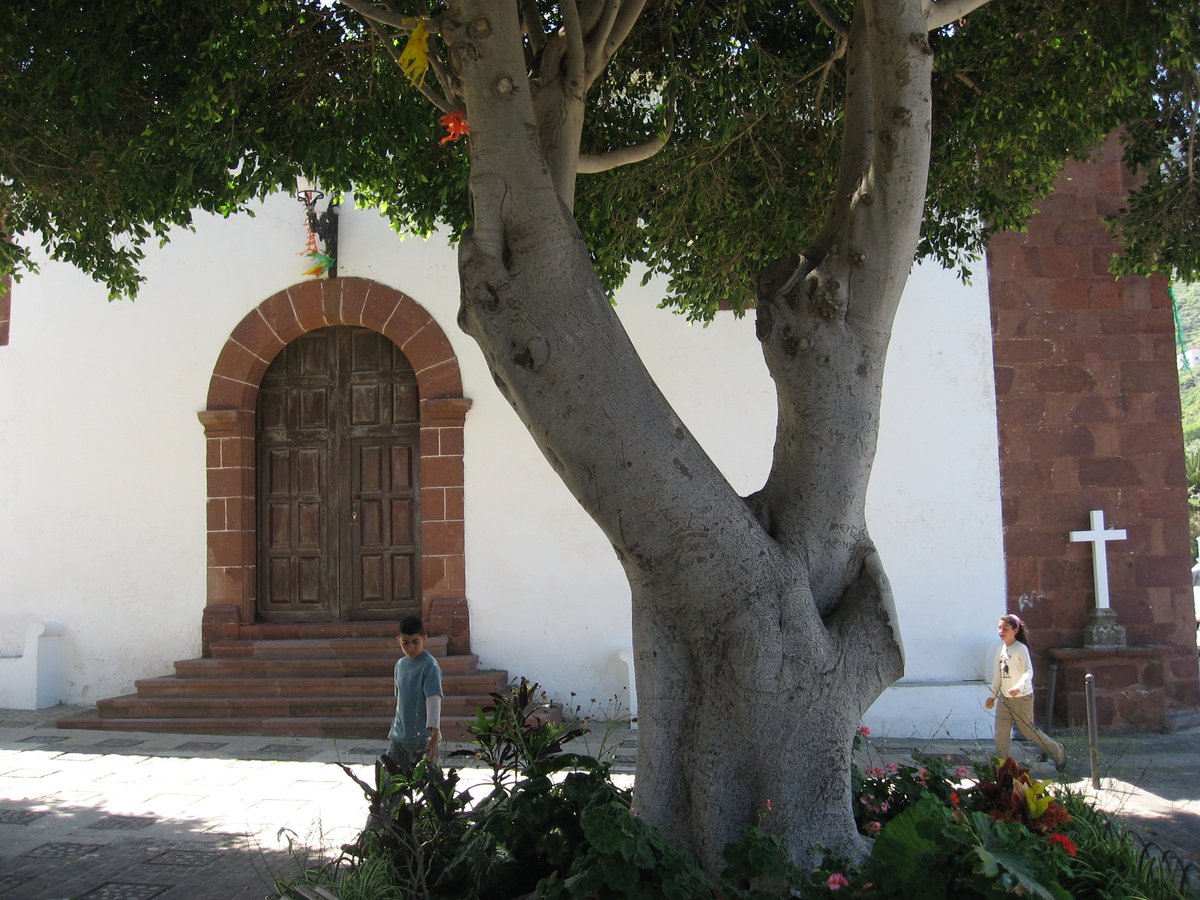

Once upon a time, in the magical realm of the Canary Islands, stood a structure as enchanting as a fairy-tale dwelling. This church, known as Iglesia de Nuestra Señora de las Nieves, resided in the breathtaking village of Taganana, embodying the rich history and culture of the islands. The story of this church is as enigmatic as the Madonna it safeguards, a statue said to have been discovered in the first decade of the 16th century by Gregorio Tabordo, one of Taganana's founding fathers.
The sculpture, now gracing the altar, is a candelero for vesting, encircled by a sun of rays and a crescent at its feet, with the Madonna of Taganana tenderly gazing at her infant Jesus in her left arm. Initially built as a small ermita around 1505, the church was eventually completed in 1728, showcasing the architectural brilliance of the Canary Islands' religious design. The church's commanding façade boasts a bell tower with three arched openings, and a red toba stone main entrance adorned with a simple acristalized oculus.
The interior of the church presents a stupendous scene, housing numerous statues, such as Father John the Baptist and Mary of Nazareth, alongside Saint Catherine, the Anonymous Announcer, the Font Baptismal, and Niño Manuel. The unaltered cultural heritage and religious significance have preserved this church in its original, enchanting state. The Fiesta de la Virgen de las Nieves is celebrated annually in August, with religious activities taking center stage.
The image is taken from the main altar and paraded throughout the town in three processions on August 4, August 5, and August 15. In 2006, Iglesia de Nuestra Señora de las Nieves was recognized as a cultural heritage site, with the protection zone extending to a polygon surrounding the church. Despite the passage of time and the changes that have transpired around it, the Iglesia de Nuestra Señora de las Nieves continues to enthrall as a resplendent symbol of hope and faith in the heart of the Canary Islands.
Sources: Wikipedia, OpenStreetMap, Wikidata, Wikimedia Commons
Written by Mutabor
Discuss this with the author and others
No comments yet. Be the first to start the conversation.