
Founded in the C3 BC during the reign of Ptolemy III Euergetes, Ptolemais was named after its gracious founder, and was designed as a perfect, rectangular city covering an expansive 280 hectares. Enclosed within a majestic wall, it served as the residence of the Ptolemaic governor, even though nearby Cyrene’s population was larger. The city showcased a hippodrome, an amphitheater, and three theaters. In the 4th or 5th century, one of these smallest theaters was converted into an enchanting venue for water spectacles.
Numerous significant artifacts and inscriptions were unearthed within the city. Ptolemais, marvelously preserved in the sands, saw the beginning of excavation during the reign of Justinian I in the 6th century. The central sector of Palazzo delle Colonne, constructed in the 2nd or 1st century BC, boasted a grand open-air peristyle adorned with 28 towering columns and a large pool. Further exploration revealed romantic dining rooms and enchanting living quarters decorated with mosaics, marble, and wall paintings in Palazzo delle Colonne.
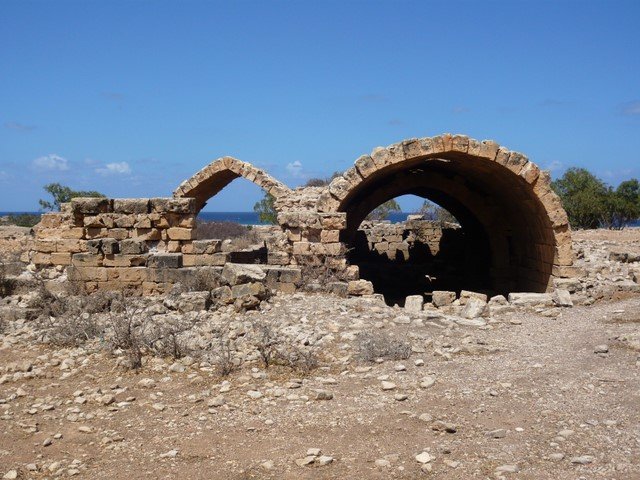
The western wing of Palazzo delle Colonne may have served as the women’s quarters, and a private bath complex equipped with frigidarium, tepidarium, and caldarium was also discovered. A Roman aqueduct brought water from over 8 km away, and two large open reservoirs in the east of the city stored this water. The Square of the Cisterns, a captivating porticoed space, stood above a set of seventeen vaulted cisterns capable of holding 7,000 cubic meters of water.
Qasr Faraoun, a striking, tower-like Hellenistic mausoleum, stands west of the city. Numerous chamber tombs were found in the quarries east and west of the city. Ptolemais served as the capital of Cyrenaica until 428, but was eventually destroyed by the Libyans in 411.
Sources: Wikipedia, OpenStreetMap, Wikidata, Wikimedia Commons
Written by Mutabor
Discuss this with the author and others
No comments yet. Be the first to start the conversation.