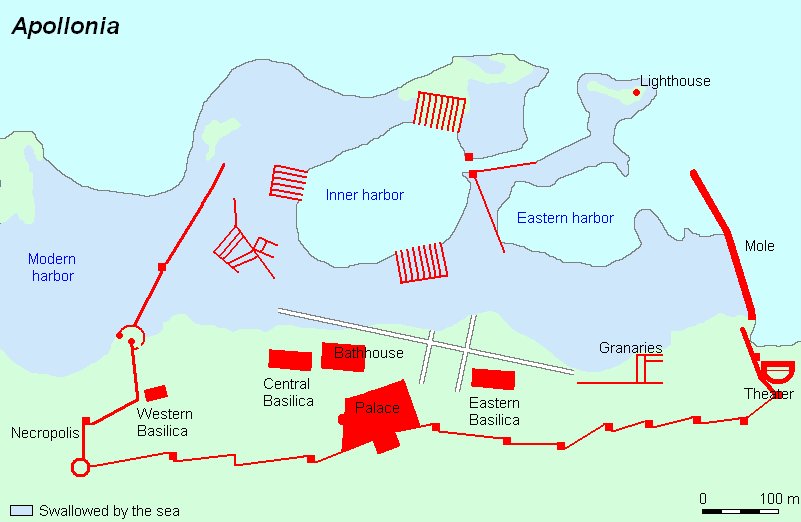

Centuries have passed and the once radiant city of Apollonia now slumbers beneath the shimmering waves off the coast of modern Libya. Initially founded by Greek colonists, Apollonia flourished to gain autonomy from Cyrene during the Roman domination. It served as Cyrene's harbor, growing to be one of the five cities of the Libyan Pentapolis. In the 6th century AD, Apollonia became the capital of the Roman province of Libya Superior or Libya Pentapolitana.
After the cessation of urban life in the ancient city following the occupation of AD 643, the city became known as Sozusa. The Greek theatre, one of the oldest sites in Apollonia, dates back to the 3rd century BC. This structure was modified under Domitian, suggesting its use as an arena for gladiatorial fights. The 5th century saw the abandonment of the theatre, with the columns from the stage being repurposed as spolia in the eastern basilica.
The cavea has 28 seat levels. The Palace of the Dux, excavated between 1959 and 1962, has over 100 rooms and was last used as the Byzantine Duke's Palace. A marble inscription testifies to its use as a Roman military commander's house, though the identification of the man who built it is problematic. The remains of the ancient port are extremely well preserved because they are underwater. Dating from the 6th/7th Century BC, the port is unique as no other complete port is this old. The Apollonia (Susa) Museum houses many artifacts found on the ancient site.
Sources: Wikipedia, OpenStreetMap, Wikidata, Wikimedia Commons
Written by Mutabor
Discuss this with the author and others
No comments yet. Be the first to start the conversation.