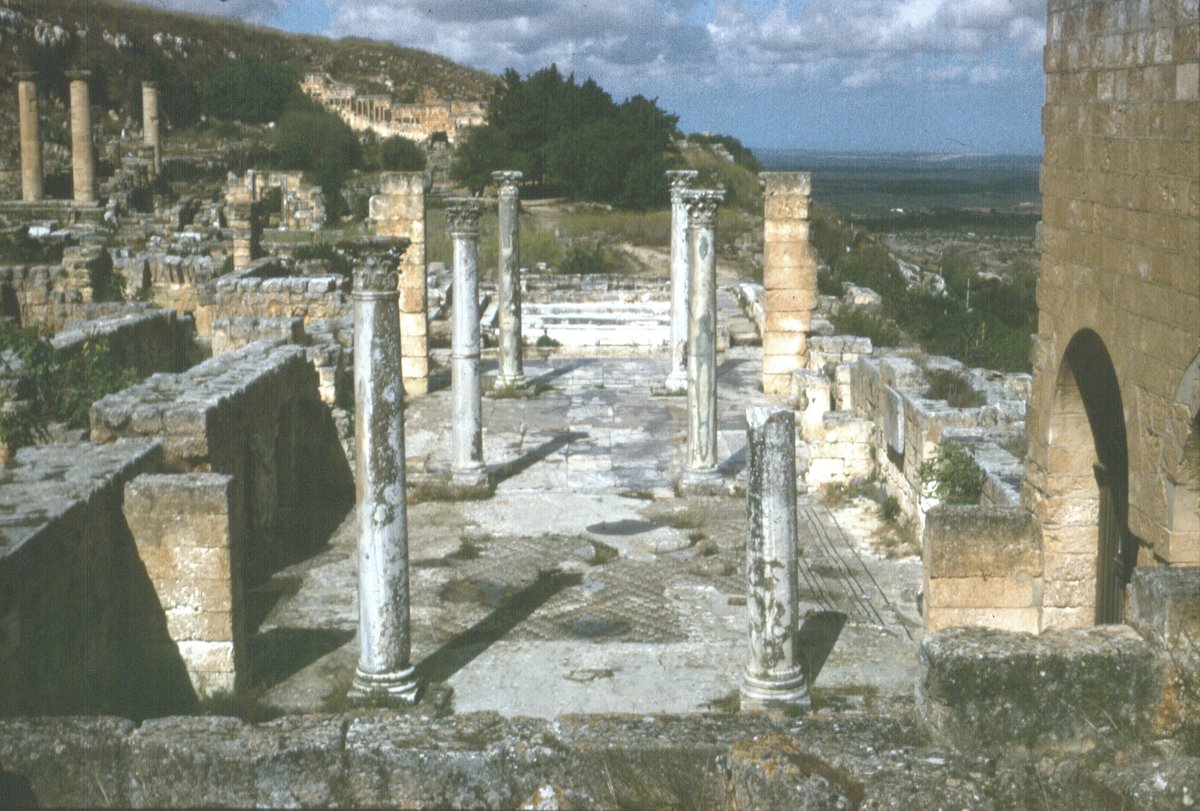

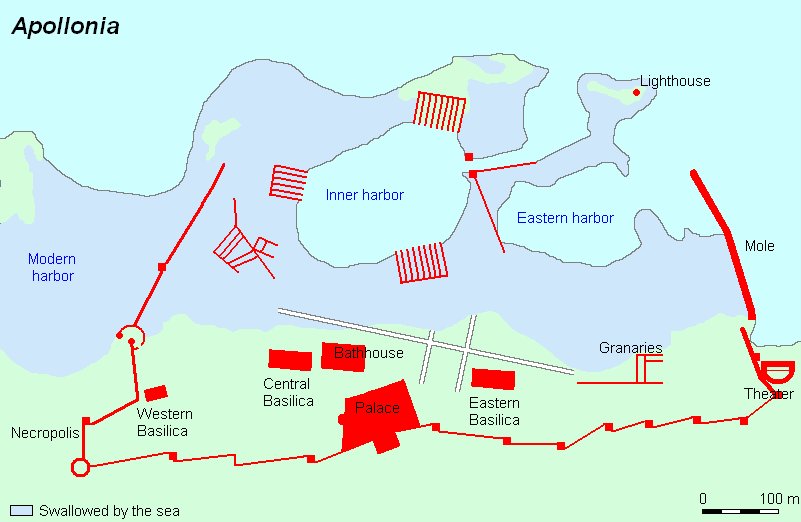
Cyrene, also sometimes anglicized as Kyrene, was an ancient Greek colony and Roman city near present-day Shahhat in northeastern Libya in North Africa. The city lies on a ridge of the Jebel Akhdar uplands. The archaeological remains cover several hectares and include several monumental temples, stoas, theatres, bathhouses, churches, and palatial residences. The city is surrounded by the Necropolis of Cyrene. Since 1982, it has been a UNESCO World Heritage Site. The city's port was Apollonia (Marsa Sousa), located about 16 kilometres (10 mi) to the north.
Greek historical traditions report that a group of Cretan Greeks, who had been expelled from Sparta and settled on the island of Thera, founded Cyrene in 631 BC under the leadership of Battus I, at the prompting of the Oracle of Delphi. Some traditions say that the settlers left Thera because of a famine, others because of a civil war. Archaeological evidence from the site, especially ceramic finds, confirm that Greek settlement began in the mid-seventh century BC. The city rapidly expanded eastwards from the initial area of habitation on a ridge stretching from the Acropolis to the Agora.
Battus II encouraged further Greek settlement in the city, especially from the Peloponnese and Crete, in the first half of the sixth century BC. This sparked conflict with the indigenous Libyans, whose king Adicran appealed to Egypt for help around 570 BC. The pharaoh Apries launched a military expedition against Cyrene, but was decisively defeated at the Battle of Irasa. Herodotus recounts conflict with king Arcesilaus II 'the Cruel' (c. 560–550 BC) led his brothers to leave the city and found the city of Barca to the west.
In the fifth century BC, Cyrene's influence over the other Greek cities in Cyrenaica seems to have solidified into institutionalised political control. The sanctuaries of Apollo, Demeter, and Zeus all go back to the seventh or sixth centuries BC. Cyrene's chief local export through much of its early history was the medicinal herb silphium, which may have been used as an abortifacient; the herb was pictured on most Cyrenian coins. Silphium was in such demand that it was harvested to extinction by the end of the first century AD. Cyrene also made money from raising of horses and the transhipment trade between Egypt, the Aegean, and Carthage. It was a landing point for Greeks seeking to visit the oracle of Ammon at Siwah.
Sources: Wikipedia, OpenStreetMap, Wikidata, Wikimedia Commons



Written by Mutabor
Discuss this with the author and others
No comments yet. Be the first to start the conversation.