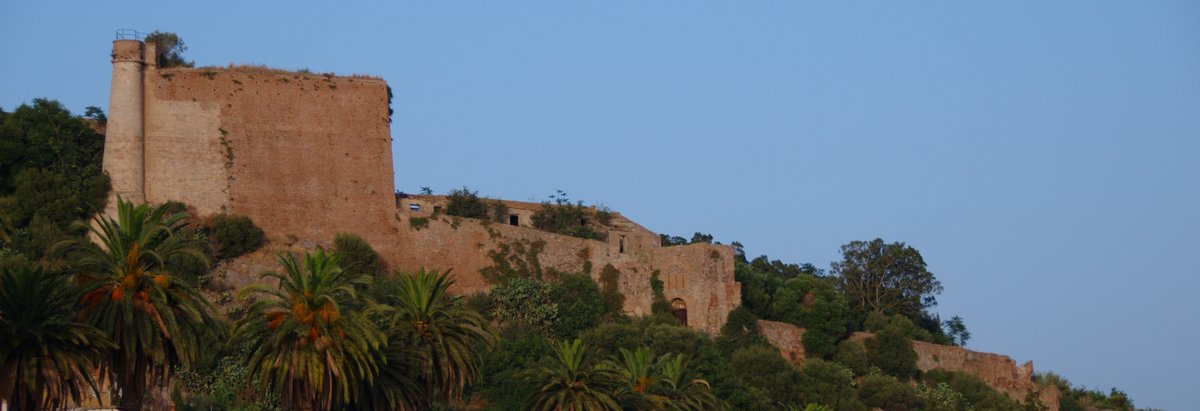

The Casbah of Béjaïa is a medieval governmental citadel located in the city of Béjaïa, Algeria, adjacent to the old town. Construction began around 1065 by the Hammadids, and it was expanded by the Almohads around 1154. In 1510, the Hafsids and the Spanish remodeled the site, followed by further modifications by the Ottomans and the French. Since 2013, the site has been undergoing restoration.
During the Middle Ages, the Casbah played a role in the transmission of knowledge and hosted various scientific and literary figures. Notable guests included the Andalusian mystic Ibn Arabi, the Italian mathematician Leonardo Fibonacci, the Catalan philosopher Raymond Lulle, the historian Ibn Khaldoun, and the Sicilian poet Ibn Hamdis. Religious figures such as Sidi Boumediene, Sidi Bou-Saïd, Sidi Abderrahman, and Thaâlibi also visited, as did travelers like Al Idrissi and Léon l'Africain.
The rectangular citadel occupies about two hectares, with its longest side extending 160 meters across a terrain with a 22-meter drop. The site contains buildings of Berber or Spanish origin, with minor Ottoman and French modifications. These include a 16th-century fort with a large vaulted hall, an ancient Berber mosque that served as a place of prayer for the Almohad governor and later a school for Ibn Khaldoun, and a square building with a patio and galleries. Two additional 19th-century buildings are also situated on the grounds.
Sources: Wikipedia, OpenStreetMap, Wikidata, Wikimedia Commons
Written by Mutabor
Discuss this with the author and others
No comments yet. Be the first to start the conversation.