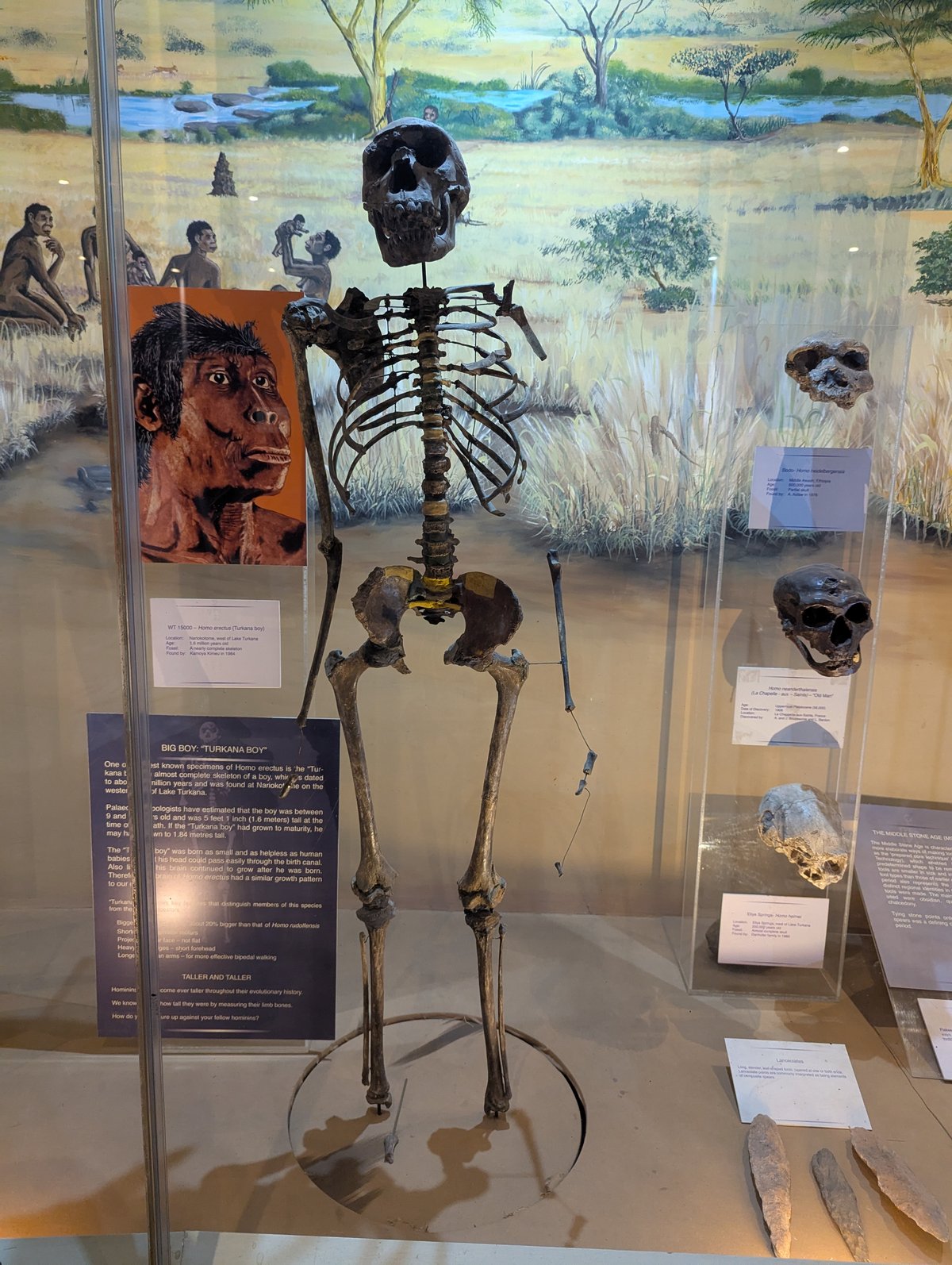

Before the world bore names, a boy dwelt by the banks of the Nariokotome River near Lake Turkana in Kenya. He was a child of Homo kin, existing 1.5 to 1.6 million years ago. In 1984, Kamoya Kimeu unearthed his remains from the dirt. These 108 bones, making the most complete early human skeleton ever discovered, provide a detailed look at an ancestral life.
He was a youth of perhaps seven to eleven years, and 2018 estimates suggest he stood 154 cm tall. His frame was adapted for the heat, with a relatively tall stature to enhance heat dissipation and prevent heat stress under the hot sun. His pelvis was narrower than that of modern humans, indicating efficient upright walking. He bore a low, sloping forehead and heavy brow ridges, yet his brain was large at 880 cc and his nose was projecting like those of humans.
Early studies suggested he suffered from a congenital disorder, but 2013 research showed his asymmetrical rib bones were characteristic of early hominins. However, the fossil definitely showed lumbar disc herniation, an injury implicated with the specimen's death. He also had a diseased mandible. Scientists conclude that his species became efficient hunters within complex social structures, though his thoracic vertebrae may have limited his motor control over certain respiratory muscles.
The fossil is held in the National Museums of Kenya, and a cast is on display. He remains a silent witness to the age when our ancestors first mastered the walking earth.
Sources: Wikipedia, OpenStreetMap, Wikidata, Wikimedia Commons



Written by Mutabor
Discuss this with the author and others
No comments yet. Be the first to start the conversation.