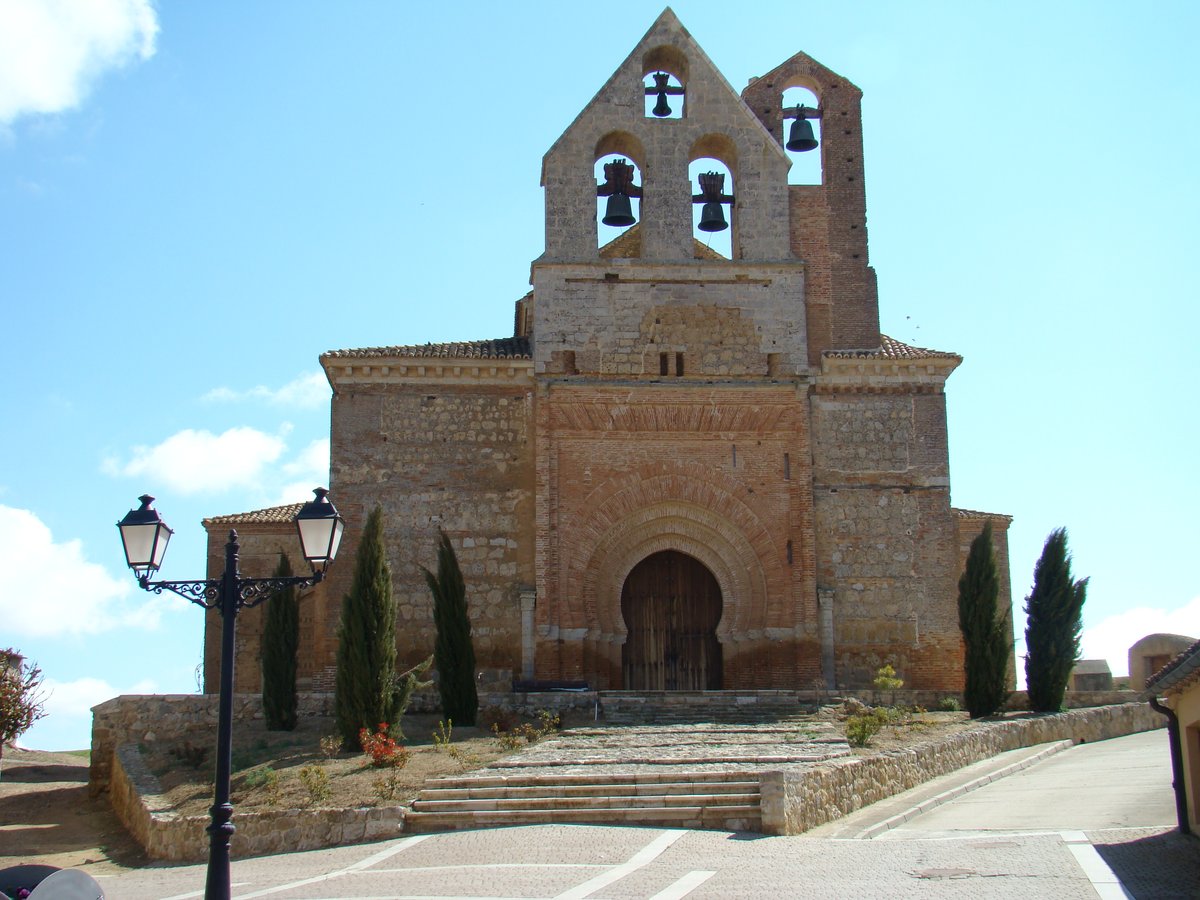

Alfonso Enríquez, a nobleman of the 14th century, under the supervision of his wife Juana de Mendoza, commissioned the construction of the Church of San Andrés in Aguilar de Campos, Valladolid. A significant example of the Gothic Mudéjar style, the Church of San Andrés is a jewel of architecture in Valladolid. Its main portal, whose Cordoba-style architecture is apparent in its masterfully pointed arch, forms the entrance. Inside, the church's structure is marked by a vaulted ceiling in its central nave, where openings seem to lead the eye straight up.
However, upon closer inspection, one realizes that these openings do not converge towards the ceiling but instead follow a curved path that eventually leads to the fault line. This ingenious optical illusion, created by the builders, was intended to make the church interior appear larger and more awe-inspiring. The Church of San Andrés houses other notable features, including a retablo, funded by the Archbishop of Burgos Manuel Cid Monroy in 1820, where San Andrés is depicted.
The Church of San Andrés was declared a National Monument of Historic-Artistic character in 1979, and a Cultural Asset of Interest in 2009.
Sources: Wikipedia, OpenStreetMap, Wikidata, Wikimedia Commons
Written by Nicolo Ciampini
Discuss this with the author and others
No comments yet. Be the first to start the conversation.