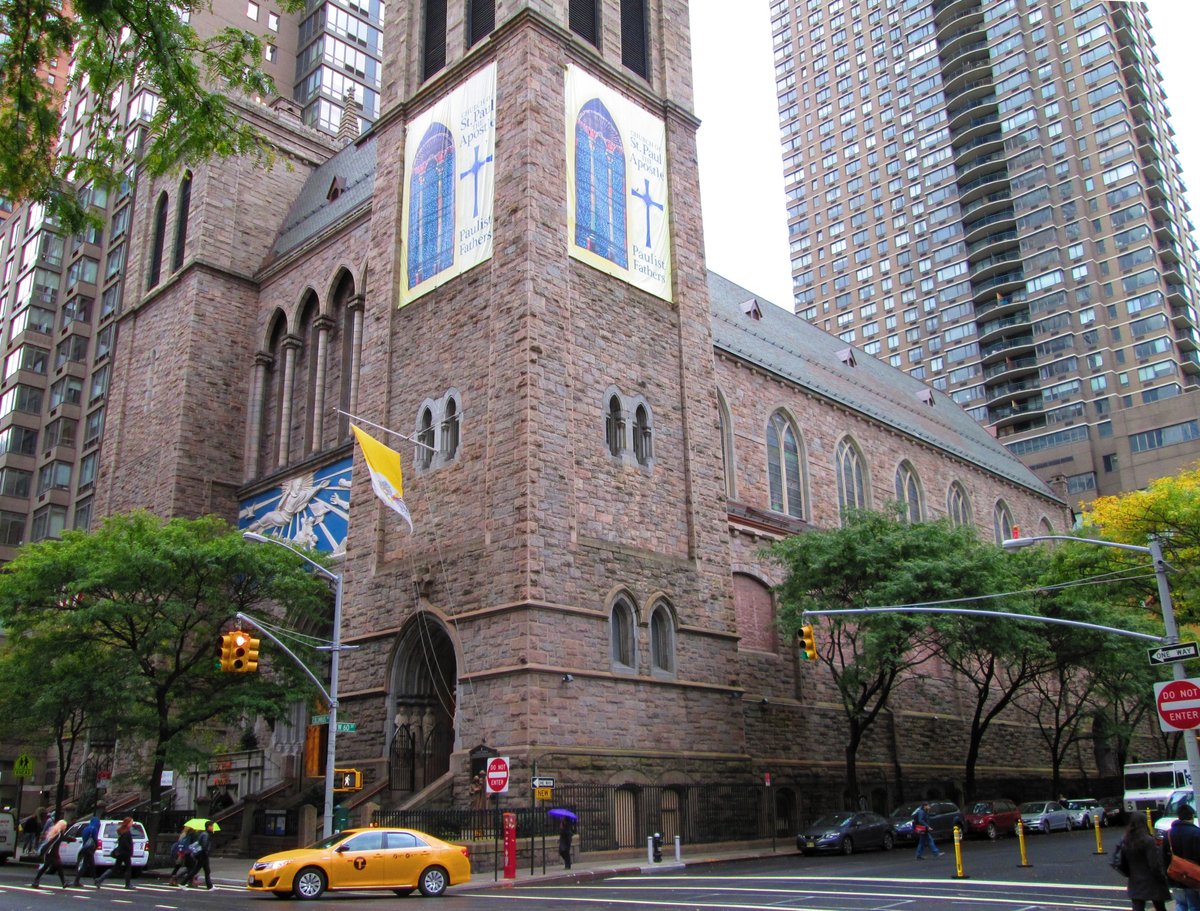
The Church of St. Paul the Apostle is the mother church of the Paulist Fathers, the first religious community of Catholic priests in the United States. The parish was founded in 1858, and the community quickly outgrew their original simple brick structure. Between 1876 and 1884, a new Late Victorian Gothic Revival-style church was built. The project saw a change in leadership when the original designer, Jeremiah O'Rourke, died six years into construction. Paulist priest George Deshon, a military engineer trained at West Point, took over the project and probably simplified the design.
The building utilized Tarrytown gray granite stones salvaged from the Croton Aqueduct and stones from other structures in Manhattan. The granite for the stone entrance steps was salvaged from the French Second Empire-style Booth's Theatre on Sixth Avenue at 23rd Street. The New York Daily Tribune described the architecture as "vast, plain, fortress-like in its solidity" and "almost repelling in the aesthetic cast."
Interior elements were designed between 1887 and 1890 by Stanford White. Isaac Hecker, who may have had a hand in the design, used the thirteenth-century Santa Croce in Florence as a model. The church features stained glass windows by John LaFarge and interior art by Augustus Saint-Gaudens and Frederick MacMonnies. Bertram Goodhue is responsible for the floor mosaics. Lumen Martin Winter's Angel of the Resurrection adorns Isaac Hecker's sarcophagus, located in the northeast corner of the nave.
Today, the church is a New York City Landmark and a functioning parish. It has survived the era of the 9th Avenue elevated train and the operation of a radio station from 1925 to 1937. A major renovation and restoration of the church began around 2000 and was still underway as of 2013.
Sources: Wikipedia, OpenStreetMap, Wikidata, Wikimedia Commons

Written by Kyle McLonely
Discuss this with the author and others
No comments yet. Be the first to start the conversation.