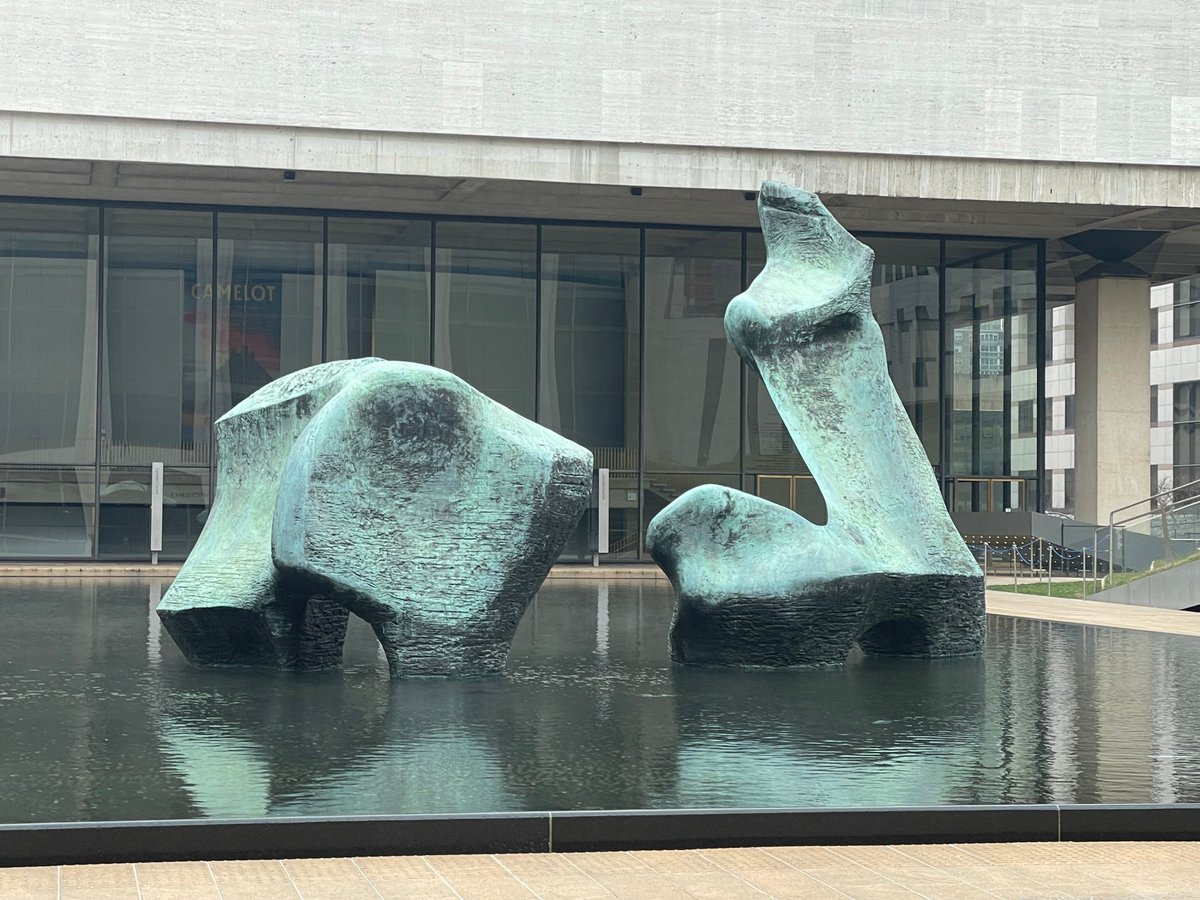
In 1965, the renowned artist Henry Moore saw his Reclining Figure installed at the Lincoln Center in New York City. Commissioned for a fee of $225,000, the sculpture stands 16 feet high and 30 feet long. Moore's ideas for the sculpture may have been inspired by a flint stone. While the center's architect, Gordon Bunshaft of Skidmore, Owings & Merrill, suggested Moore for the commission, some members of the Lincoln Center Arts Committee initially objected to the selection of a European sculptor.
Moore visited the site in 1962 and noted that the pool was as big as a cricket pitch. He decided to work on a concept of a woman and rock rising from the water, attracted by the way the work would be reflected in the water. To develop these ideas, Moore worked on early clay or plaster maquettes in 1962. Two of these maquettes were increased in scale to create half-size plaster working models, each supported by an armature, which Moore worked on with chisels and other tools.
After the full-scale plaster model was completed in August 1964, it was cut into pieces and cast in bronze at the Hermann Noack foundry in Berlin. The sculpture was installed at the Lincoln Center on 21 September 1965. Today, several versions exist, including a bronze cast at the MIT List Visual Arts Center and a third version located on Henry Moore’s estate in Hertfordshire, England.
Sources: Wikipedia, OpenStreetMap, Wikidata, Wikimedia Commons
Written by Leroy
Discuss this with the author and others
No comments yet. Be the first to start the conversation.