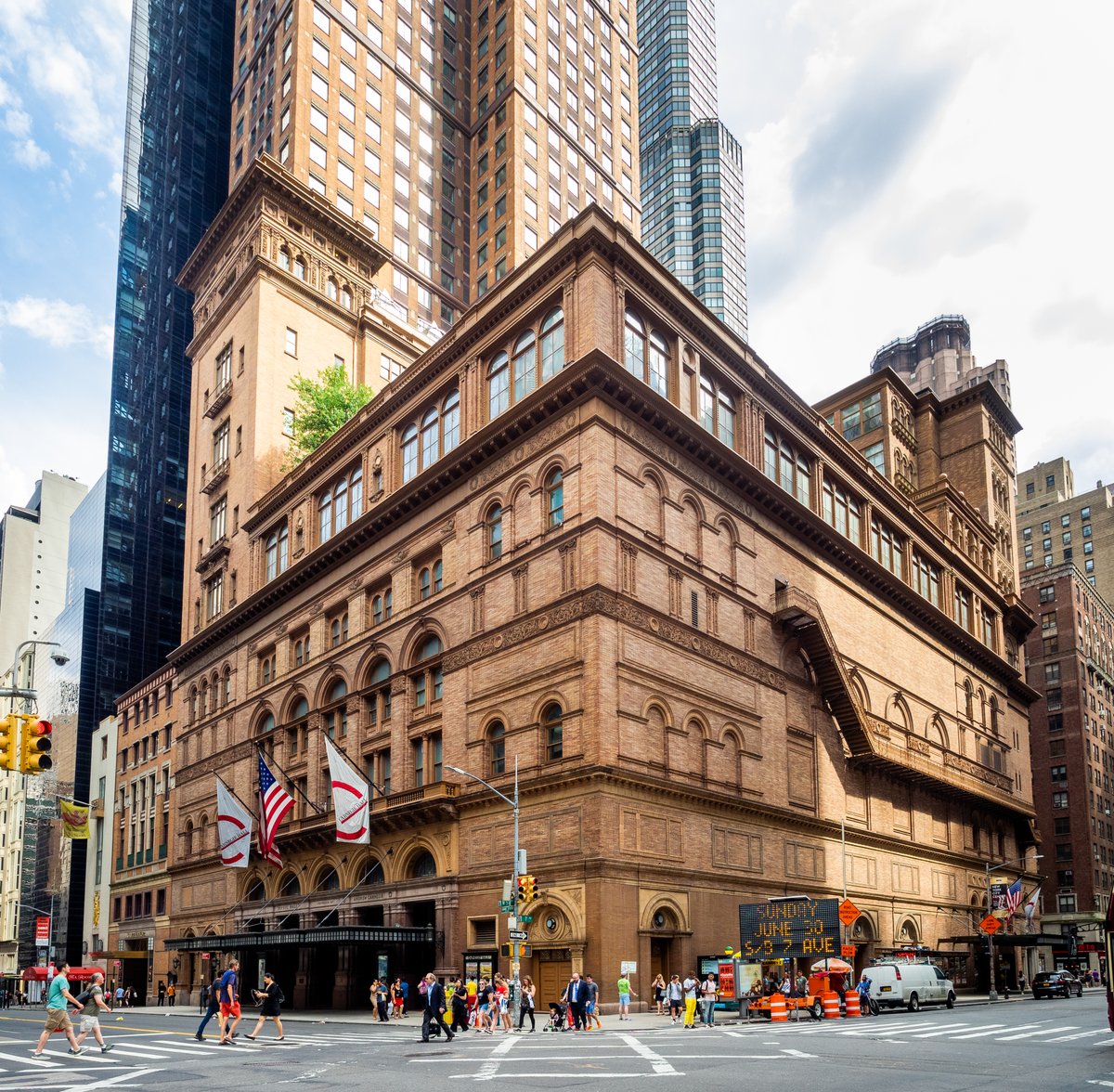
Nestled in the heart of Midtown Manhattan, Carnegie Hall was constructed between 1889 and 1891 by industrialist and philanthropist Andrew Carnegie. Designed by William Burnet Tuthill, the venue stands as a National Historic Landmark and a New York City designated landmark. It sits on the east side of Seventh Avenue between 56th and 57th Streets, sharing a city block with the Carnegie Hall Tower, Russian Tea Room, and Metropolitan Tower.
Once faced with the threat of demolition in the 1950s, the venue was saved by a public campaign led by violinist Isaac Stern. Today, it serves as a premier location for both classical and popular music, housing three distinct performance spaces. These include the 2,790-seat Stern Auditorium, the 599-seat Zankel Hall, and the 268-seat Joan and Sanford I. Weill Recital Hall.
The complex features three structures arranged in an L-shape. The original building houses the Stern Auditorium, while the 16-story eastern wing contains the Weill Recital Hall and the 13-story southern wing contains Zankel Hall. With its own artistic programming, development, and marketing departments, the hall continues to be a major cultural site in the city's historic artistic hub.
Sources: Wikipedia, Wikidata, Wikimedia Commons




Written by No Other
Discuss this with the author and others
No comments yet. Be the first to start the conversation.