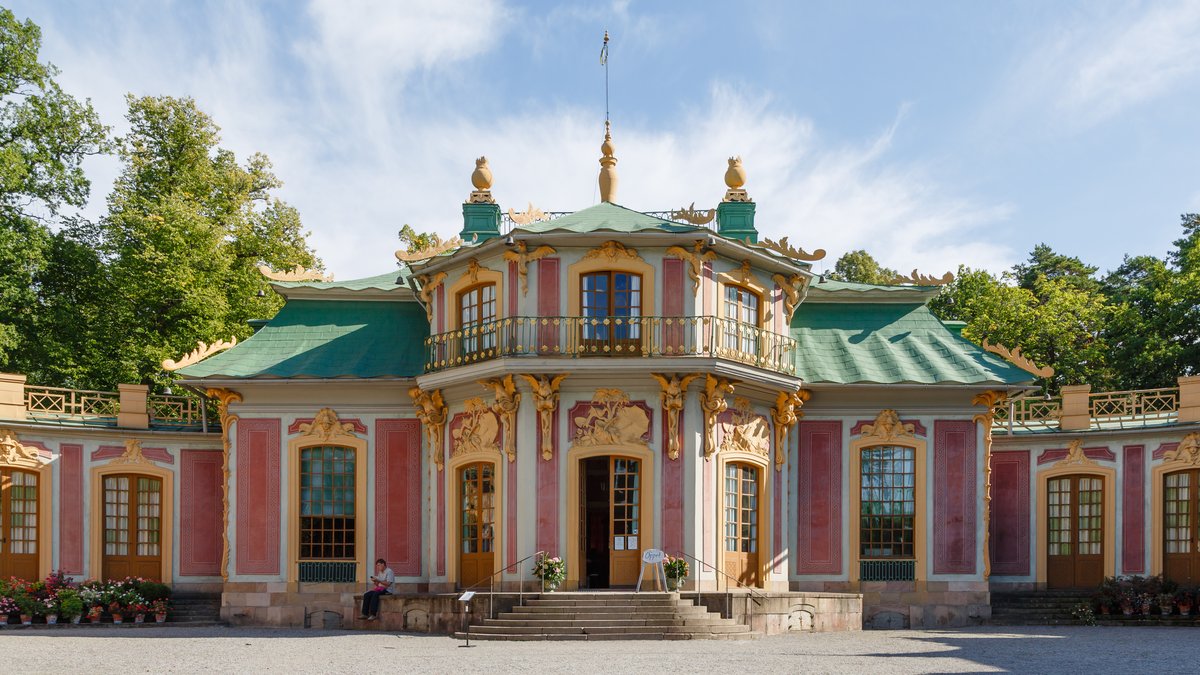

The Chinese Pavilion is a former royal palace in Drottningholm, a suburb of Stockholm. The pavilion was built between 1753 and 1769 as a surprise gift to Queen Lovisa Ulrika, wife of King Adolf Frederick, on her birthday in 1753. The original wooden structure was designed by Carl Hårleman and Carl Johan Cronstedt and was a gift from King Adolf Frederick to Queen Lovisa Ulrika on her birthday in 1753.
Construction of the pavilion started in August 1752, and the first part was completed in June 1753. A second, more grandiose structure was commissioned in 1763 when the original one began to rot, and it was completed in 1769.
The current structure is an example of rococo and chinoiserie architecture. The pavilion was designed by Carl Fredrik Adelcrantz and the interior was designed by Jean Eric Rehn.
The walls of the Yellow Room are covered with Chinese lacquered panels depicting relations between Asia and Europe in the 18th century. The Chinese Pavilion also has four small houses in Chinese style to the north of the pavilion, including The Billiard, The Silver Chamber, Adolf Frederick's Studio and The Confidence. The Confidence has a dining room where tables could be hoisted up through the floor for confidential dining.
The Chinese Pavilion became a museum in 1963 and underwent renovations in 1927–1928, 1943–1955, 1959–1968, and 1989–1996.
Sources: Wikipedia, OpenStreetMap, Wikidata, Wikimedia Commons
Written by Nik Frost
Discuss this with the author and others
No comments yet. Be the first to start the conversation.