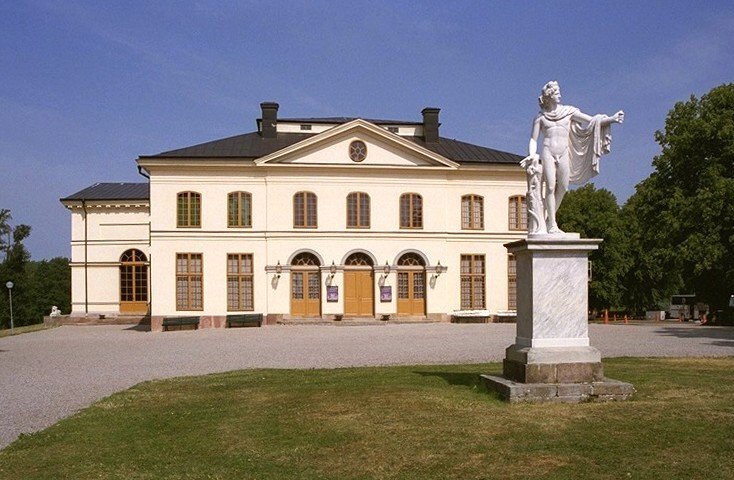

The Drottningholm Palace Theatre is an opera house located at Drottningholm Palace in Stockholm, Sweden. It is one of the few 18th-century theatres in Europe that is still used as a theatre with its original stage machinery. The first theatre to be built on the Drottningholm site was built at the behest of Queen Lovisa Ulrika by the German master builder Georg Greggenhofer in 1718 or 1719. The theatre opened in 1754 and hosted a new troupe of French actors, the Du Londel Troupe, that had been engaged by the court a year earlier and was to use the theatre until 1771.
The troupe used the theatre in the summer months to show French theatre and Italian opera for the Queen and her court. When the original theatre burned down on 27 August 1762 during the performance of a comic opera, Queen Lovisa Ulrika quickly decided to rebuild a theatre for the Drottningholm Palace court, commissioning a replacement opera house by Carl Fredrik Adelcrantz. Work began on the building in 1764, and it eventually included the theatre as well as a complex of smaller chambers off the main auditorium to house members of the court who did not stay at the palace, including Adelcrantz, the master of the revels, the noble chambermaids, the actors and staff of the theatre, and young aristocrats.
The building that Adelcrantz created was unusual architecturally in several respects. Most notably, although the theatre was intended to mimic Versailles's artistic style, the lack of funds of the Swedish Treasury forced a much sparser style. The exterior of the building is very plain in comparison to other palatial theatres, in the style of a country manor with no indication from the exterior that an opera house is inside. The interior, decorated by Adrien Masreliez, uses trompe l'oeil, papier-mâché, and stucco to imitate more expensive materials like marble and gold.
The theatre is also architecturally unusual for its shape, since the auditorium is shaped like a T with the two thrones for the reigning monarchs placed in the cross of the T in front of the stage and the rest of the court seated on wooden benches. The stage is also unusually deep, 27 by 57 ft (8.2 by 17.4 m), which helped the set designers to create optical illusions of great distance on the stage. After the theatre was rebuilt following the fire, the theatre was used every summer by the court until 1771, when the French acting troupe was dismissed.
The theatre remained unused until 1777, when Queen Lovisa Ulrika gave it to her son, King Gustav III. The King was interested in the theatre and hired an acting troupe to perform in it. French and Italian theatre continued to be performed, but King Gustav encouraged Swedish stories and language. The theatre was used as a storage room for Drottningholm Palace's unused furniture after King Gustav III's assassination in 1792. The theatre was rediscovered by Agne Beijer in 1921, and with royal permission, it was preserved.
Electric lights were added to the theatre in 1921, and small changes were made to the theatre. The theatre reopened on August 19, 1922, but performances were limited to occasional showcases from 1922 to 1935. The theatre began hosting seasonal performances in 1935, and in 1951, the Royal Swedish Opera became the permanent company performing in Drottningholm Theatre. The Royal Swedish Ballet joined the Opera in partnership in 1953.
Sources: Wikipedia, OpenStreetMap, Wikidata, Wikimedia Commons
Written by Nik Frost
Discuss this with the author and others
No comments yet. Be the first to start the conversation.