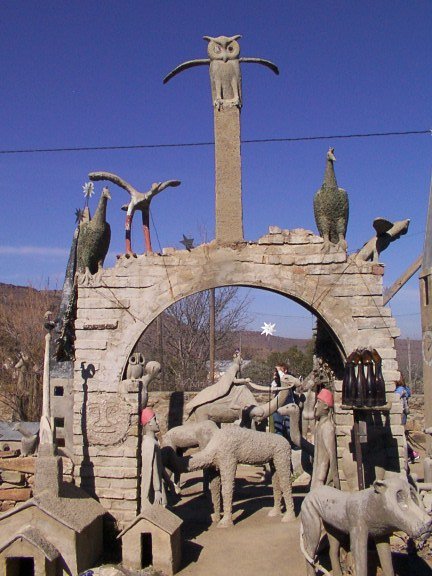

In the town of Nieu-Bethesda in the Eastern Cape of South Africa, the Owl House stands as a museum of the visionary work of Helen Martins. Martins was a reclusive artist who inherited the house from her parents and began transforming it into a unique environment after their deaths. She covered interior surfaces with ground glass and used mirrors and lights to enhance the illumination inside.
Martins spent years creating this environment, often working with locals like Jonas Adams and Piet van der Merwe to make structural alterations. Her partner and lover, Johannes Hattingh, constructed the first cement animals and built much of the early bestiary. In 1964, she was joined by Koos Malgas, who helped her build the sculptures in the outside area known as the Camel Yard. These more than 300 sculptures - including owls, camels, peacocks, and pyramids - are mostly oriented toward the east as a tribute to Martins' fascination with the Orient.
Martins was inspired by Christian biblical texts, the poetry of Omar Khayyam, and the works of William Blake. Her life and work became a subject of popular culture, including a play by Athol Fugard called The Road to Mecca. Although her relationship with her community was often complicated, she invited neighbors to view her house when decorated for Christmas. The Owl House was declared a provincial heritage site in 1989 and opened as a museum in 1992.
After years of exposure to the fine crushed glass used to decorate her walls and ceilings, Martins' eyesight began to fail. She attempted suicide on 6 August 1976 and died in a hospital in Graaff-Reinet later that day at the age of 78. As per her wishes, the Owl House has been kept intact as a museum, managed today by the Owl House Foundation.
Sources: Wikipedia, OpenStreetMap, Wikidata, Wikimedia Commons
Written by Mutabor
Discuss this with the author and others
No comments yet. Be the first to start the conversation.